
|
|
The changing of the avant-garde : Postmodern roots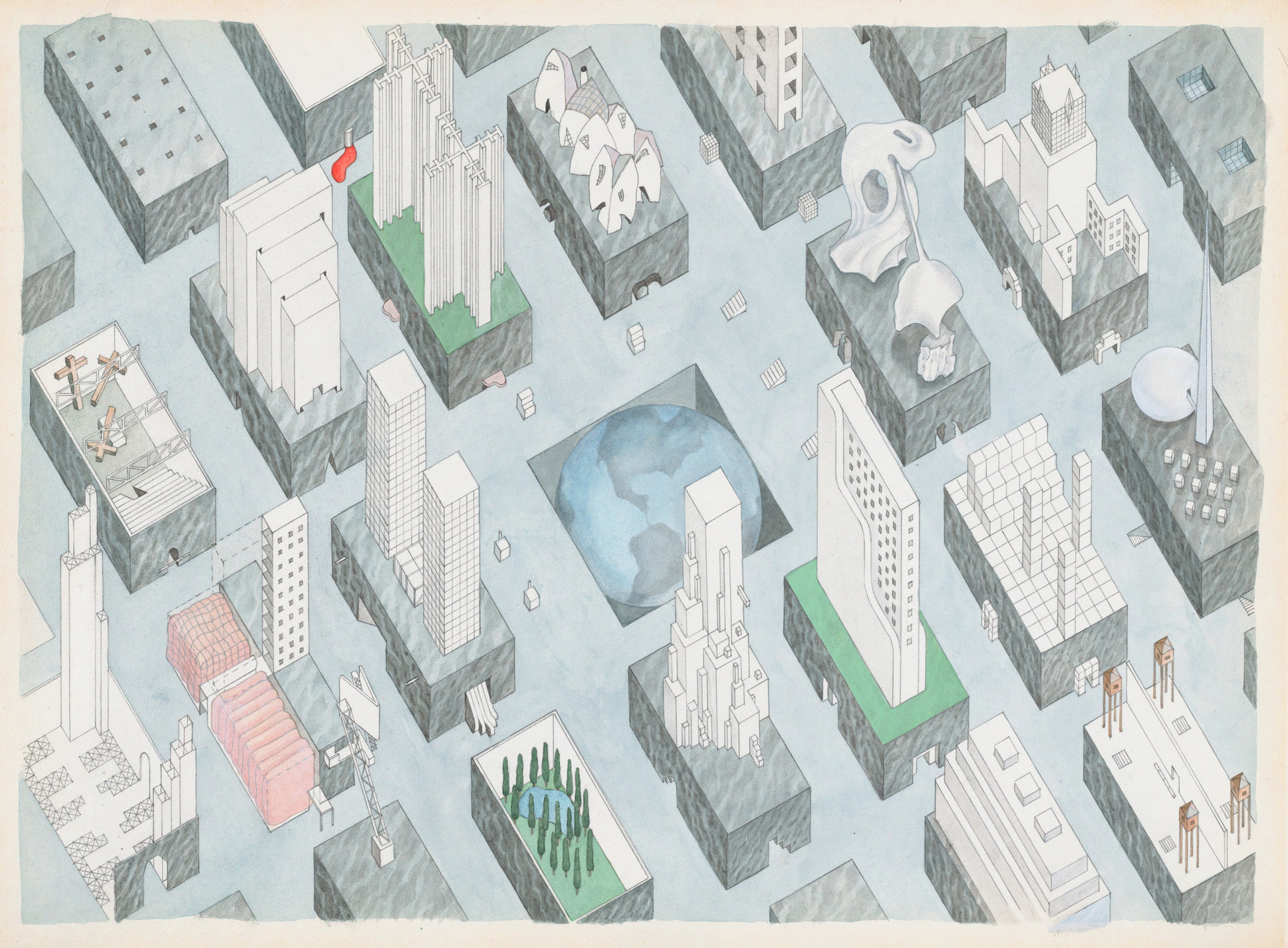
Rem Koolhaas, Madelon Vriesendorp. The City of the Captive Globe Project, New York, New York, Axonometric. 1972. Gouache and graphite on paper, 12½ × 17⅜" (31.8 × 44.1 cm)
PLATES: POSTMODERN ROOTSOswald Mathias Ungers
German, 1926–2007
with G. Geist and Jürgen Sawade
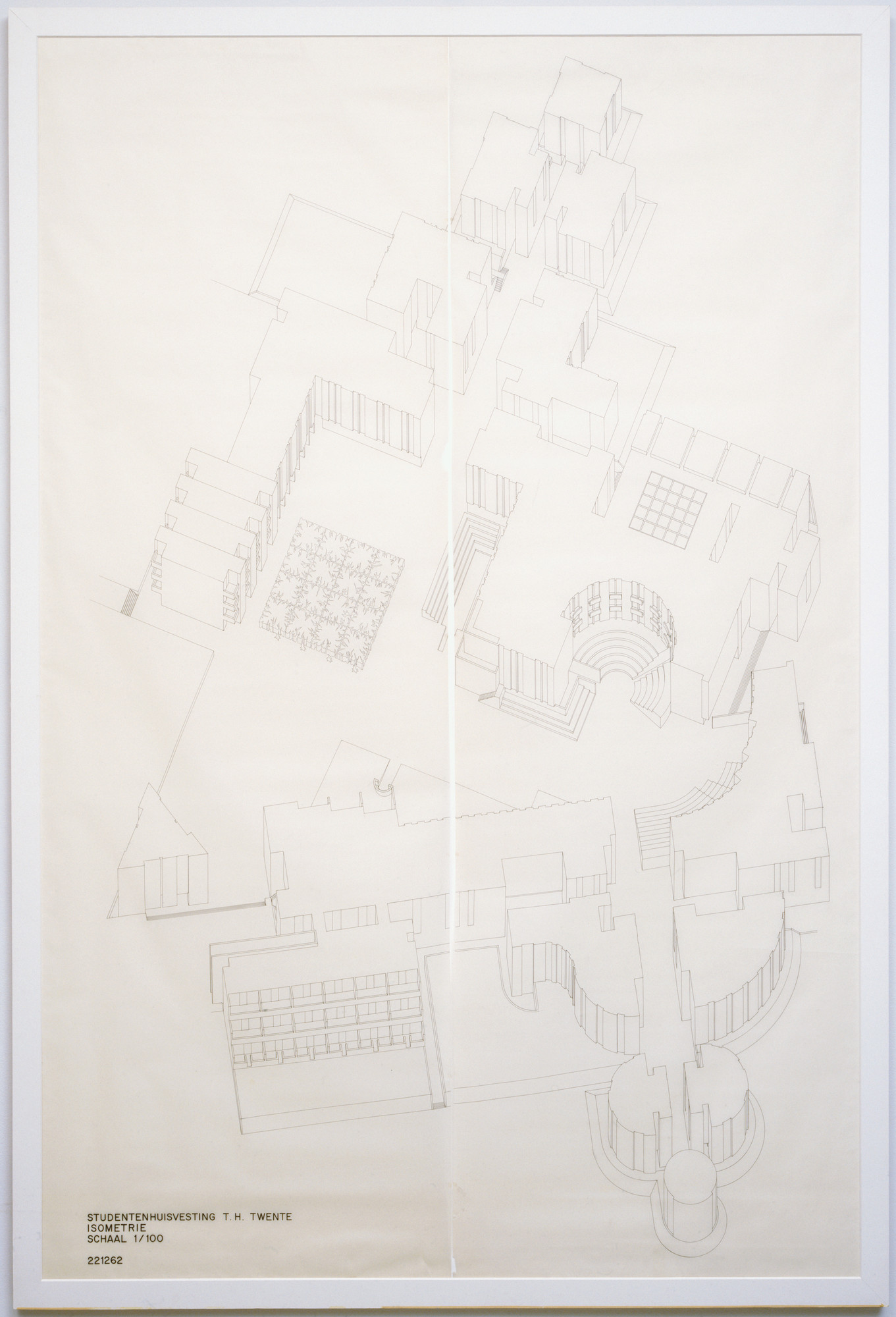
Mathias Ungers, G. Geist, J. Sawade. Student Housing Project, Enschede, The Netherlands, Isometric. 1964. Ink on tracing paper. 87 × 57½" (221 × 146.1 cm)
Oswald Mathias Ungers's unrealized proposal for student housing was done for a competition sponsored by the University of Technology, Twente, the Netherlands. The monumental Enschede dormitory at first appears to be designed in a traditional Beaux-Arts plan, incorporating classical circular and rectangular courtyards, on axis; but in fact the lower portion has been sliced open, shifted, and rotated. Such a permutation undermines the integrity of the perimeter, and fragments what appears to have been once a stable form. The viewer's sense of instability increases as the perspective in the drawing shifts at the point where the building complex pivots. During the time he conceived this project, Ungers was highly influenced by the Russian Constructivists" monumental and dynamic forms and by Giambattista Piranesi's sublime fragmented images.
Arata Isozaki
Japanese, born 1931
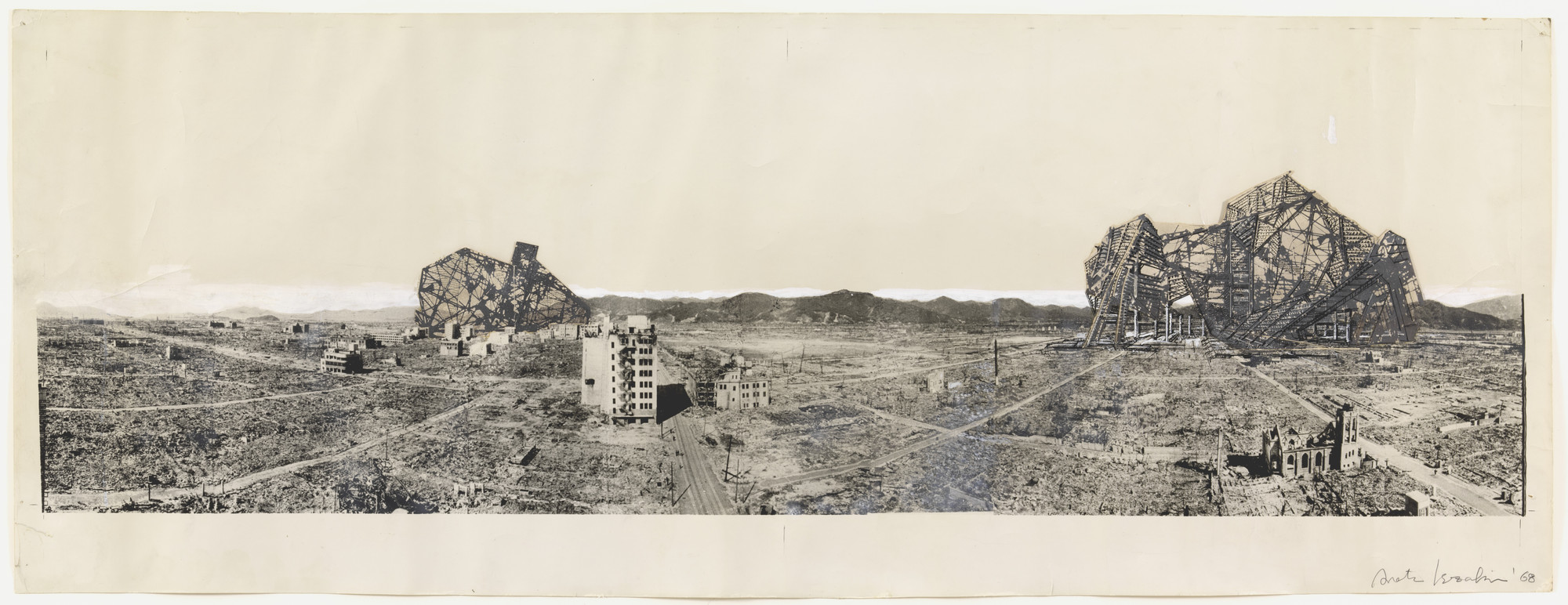
Re-ruined Hiroshima, project, Hiroshima, Japan (Perspective). 1968. Ink and gouache with cut-and-pasted gelatin silver print on gelatin silver print, 13⅞ × 36⅞" (35.2 × 93.7 cm)
Haunted by the remaining destruction of Hiroshima twenty-two years after the atomic bomb was exploded there, Arata Isozaki has projected images of his megastructures onto a photomural of the razed city. In this image his constructions are also in ruins. It is as if he had rebuilt Hiroshima, and it had once again undergone destruction. Ruins provide an important metaphor for Isozaki: "They are dead architecture. Their total image has been lost. The remaining fragments require the operation of the imagination if they are to be restored."
Andrea Branzi (Archizoom)
Italian, born 1938
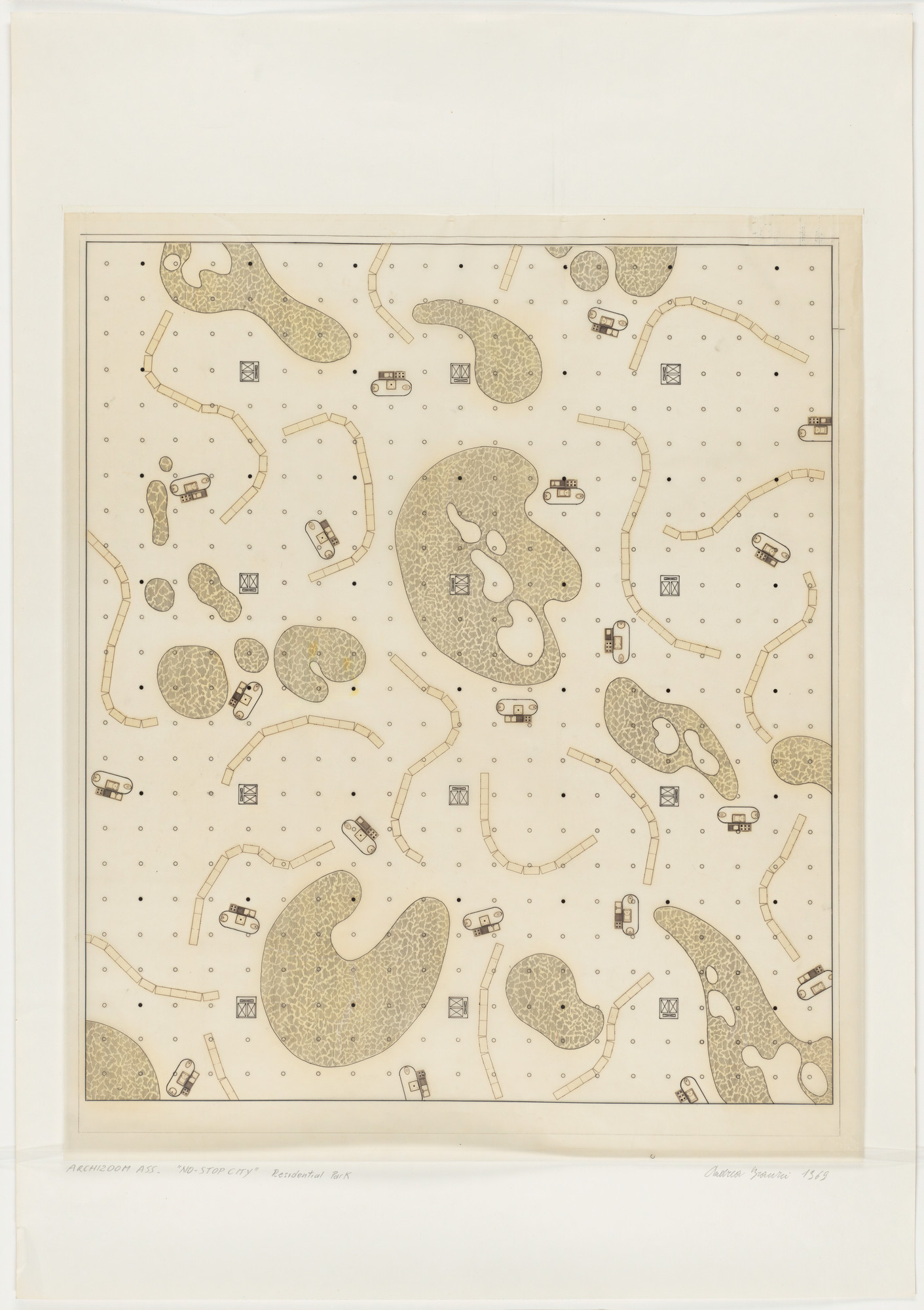
Andrea Branzi. Residential Park, No-Stop City project (Plan). 1969. Ink, cut-and-pasted self-adhesive polymer sheet, and pressure-transferred printed film on tracing paper, taped to paper. 39¼ × 27⅜" (99.7 × 69.5 cm)
Andrea Branzi, a founding member of Archizoom, the Italian avant-garde architectural group begun in 1966, was inspired by the urban utopias of the British group Archigram. His Residential Park, No-Stop City, like other works of Archizoom, is a reaction against modernist architecture that explores the imaginative at the expense of the practical. In this drawing, which presents an idea rather than an actual plan, technology eliminates the need for a centralized city. Biomorphic forms, placed haphazardly over an infinitely extendable grid represent acclimatized microenvironments, for example, green amoeba-like forms are parks, and the serpentine strings are housing units.
Léon Krier
Luxembourger, born 1946
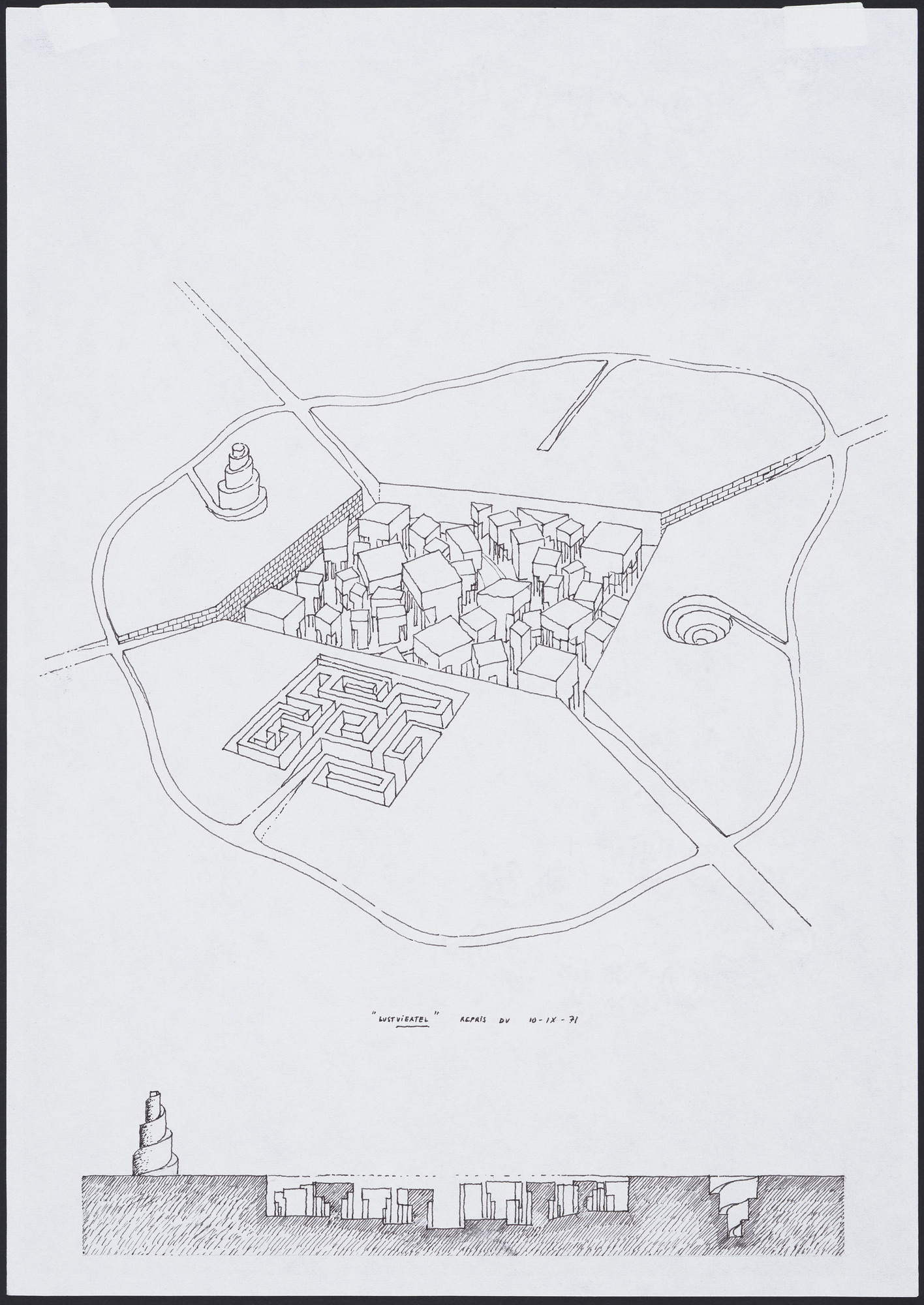
Leon Krier. Labyrinth City. Project, 1971. Aerial perspective and section: ink with gouache on paper, 11⅝ × 8¼" (29.5 × 21 cm)
Between 1967 and 1974, while pursuing urban projects, Krier also produced numerous drawings of architectural follies, including this work. He pictured the structures in his drawings—inspired by vernacular architecture or structural engineering—in remote locations, such as mountains, deserts, and Mediterranean islands. These visionary projects, inspired by both real circumstance and the architect’s dreams, were conceived for specific individuals, such as friends or people whom Krier admired from a distance. In these personal projects, he sought an escape from the formal and social principals of the modern masters and a rediscovery of essential methods of construction. He used fictional motifs to both reinvent architecture and shift its role as a definer of existing social and spatial structures. Krier continued to pursue an architecture that rejected modernism and contemporary technology, laying the political foundation for so-called New Urbanism, a movement that reclaimed the civic pedestrian townscape from an increasingly automotive urban society.
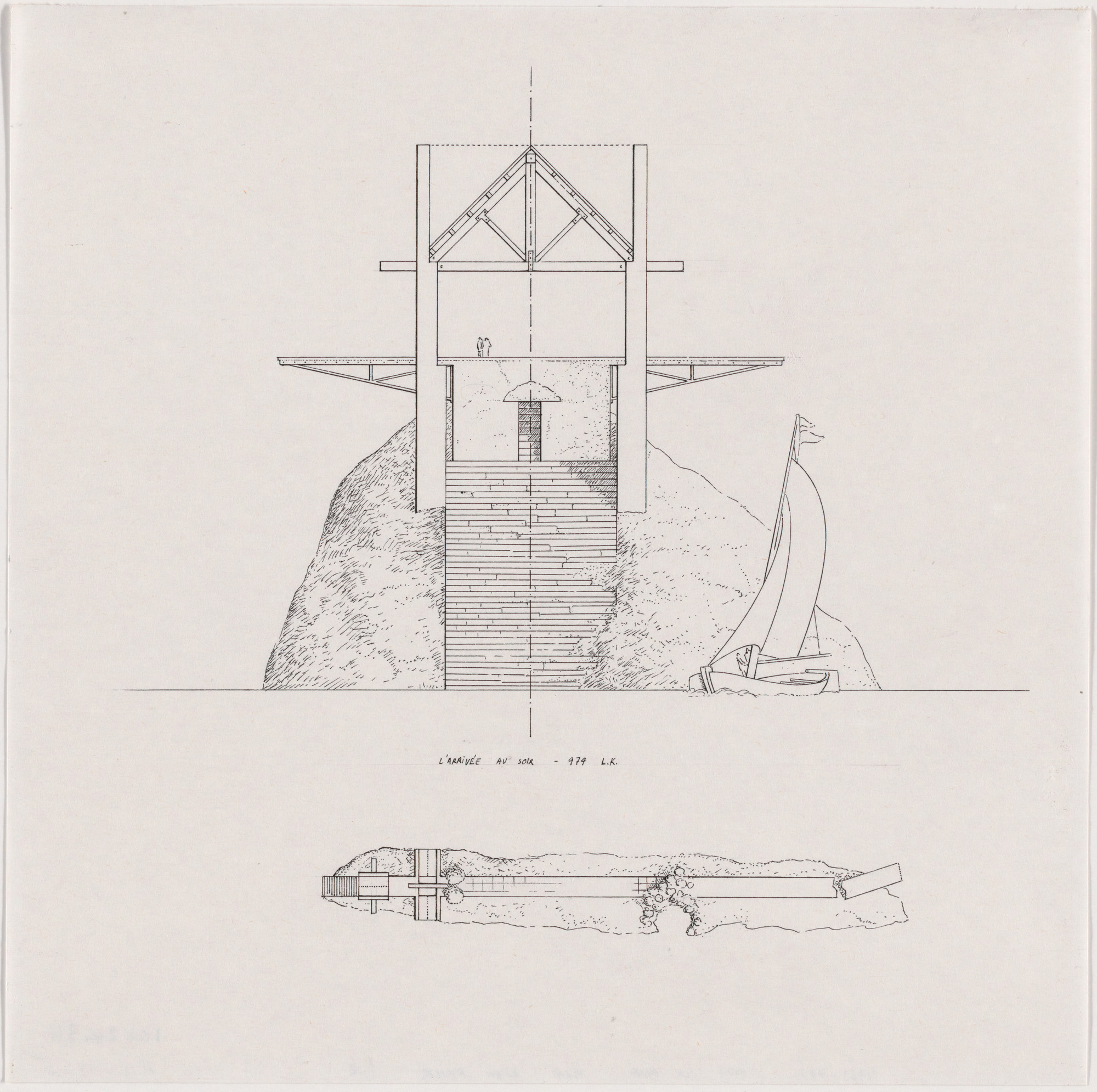
Leon Krier. House for Rita. Project, 1969–74. Perspective and plan (1974): Ink on paper, 8¼ × 8¼" (20.9 × 20.9 cm)
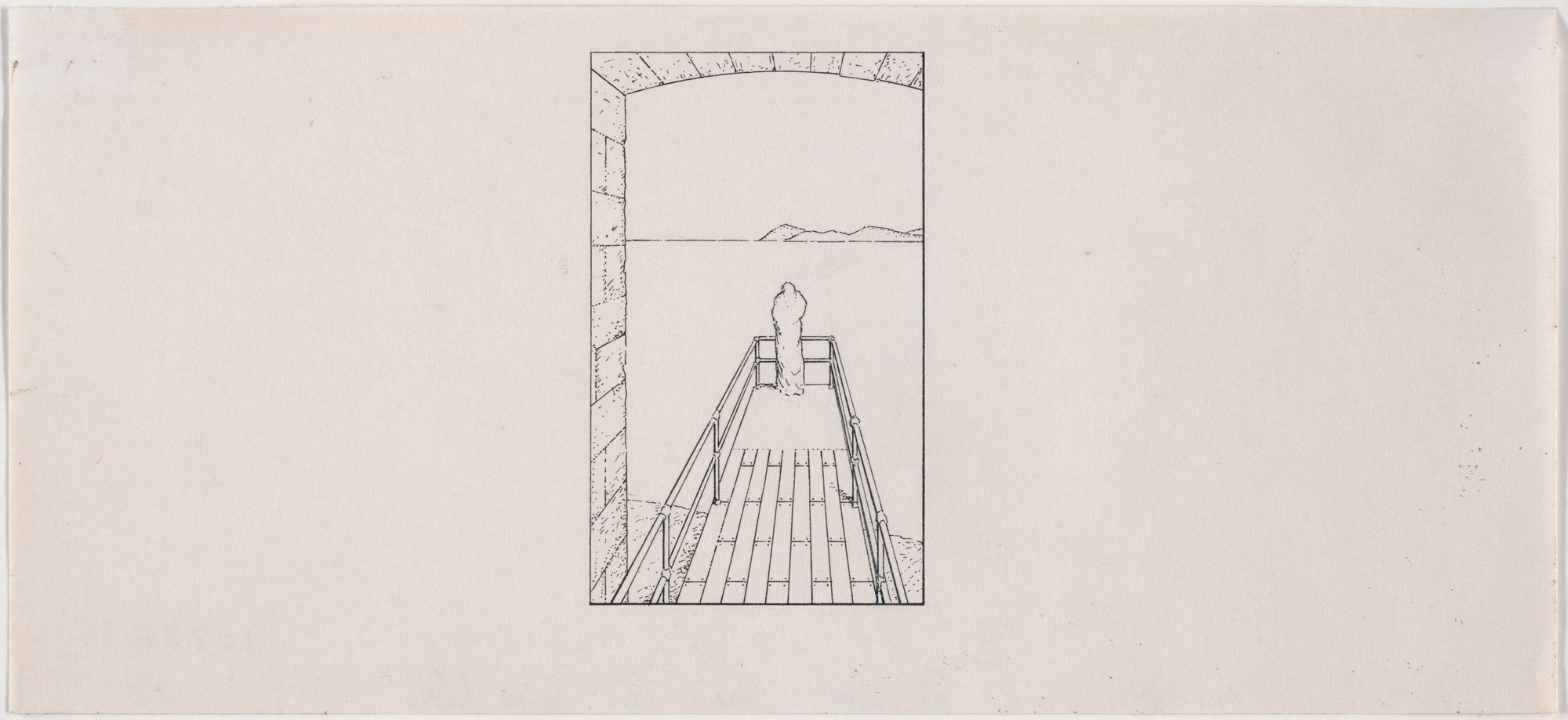
Leon Krier. House for Rita. Project, 1969–74. Perspective (1974): ink on paper with gouache, 3¾ × 8¼" (9.5 × 21 cm)
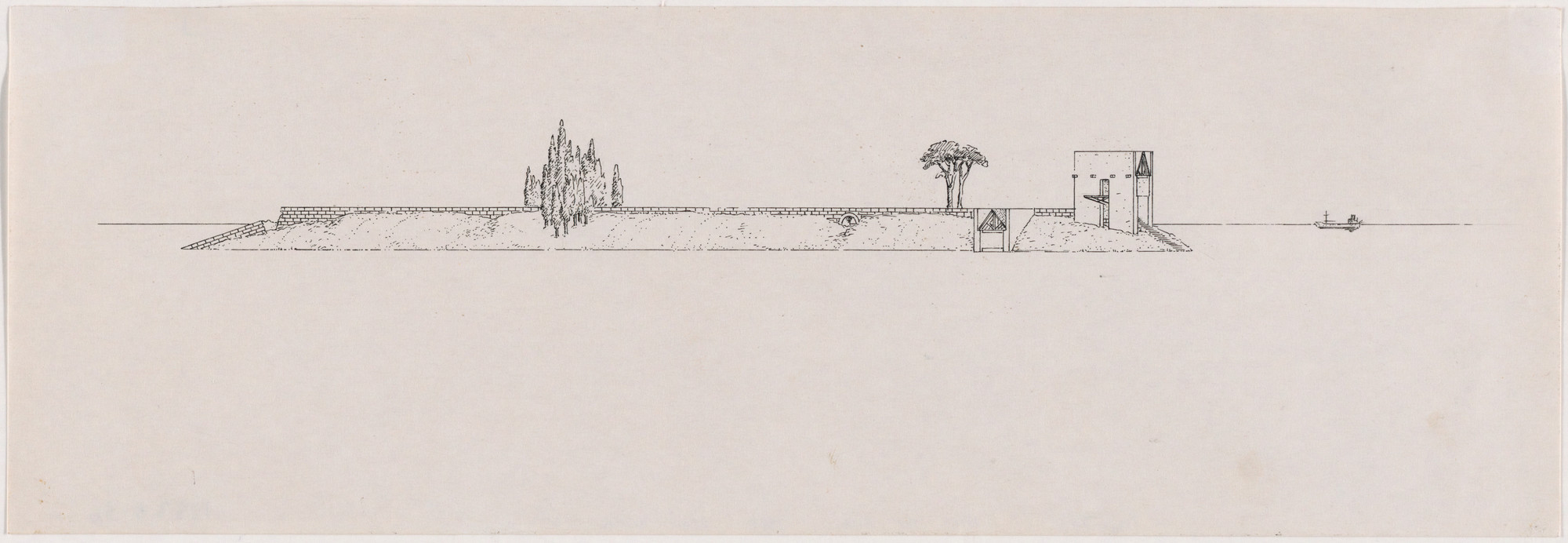
Leon Krier. House for Rita. Project, 1969–74. Elevation (1974): ink on paper, 4 × 11⅝8" (10.2 × 29.5 cm)
Alessandro Mendini
Italian, born 1931
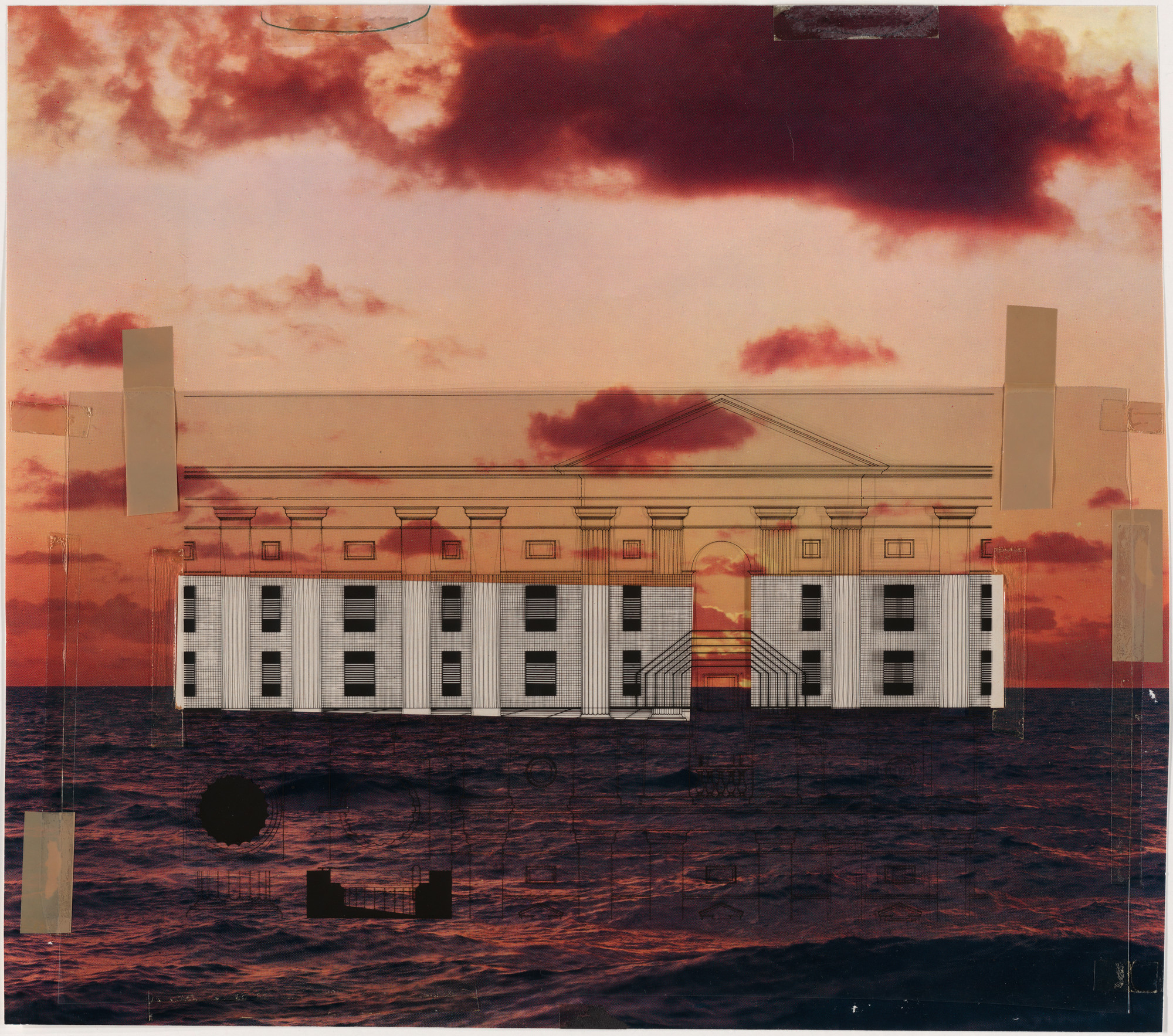
Alessandro Mendini. Housing. Project, 1971. Elevation. Printed polymer sheet with tape on lithograph, 19⅞ × 22¼" (50.5 × 56.5 cm)
Alessandro Mendini's design for the facade of this house appeared on the cover of the Italian design magazine Casabella, during the international debate sparked by radical architecture in the early 1970s. Mendini's drawings embody two of the opposing views prevalent within the debate: they reveal an architecture of unmediated structures not intellectualized by means of drawing and an architecture that is abstract, conceptual, and full of linguistic references. In this drawing, which shows the front of the house in muted light, Mendini has projected onto the flat facade an image of the elevation of a Greek temple, the lower section and columnar spacing of which determine the proportions and fenestration. Mendini believed that architecture, if connected to the image of ancient construction, could gain in energy and feeling.
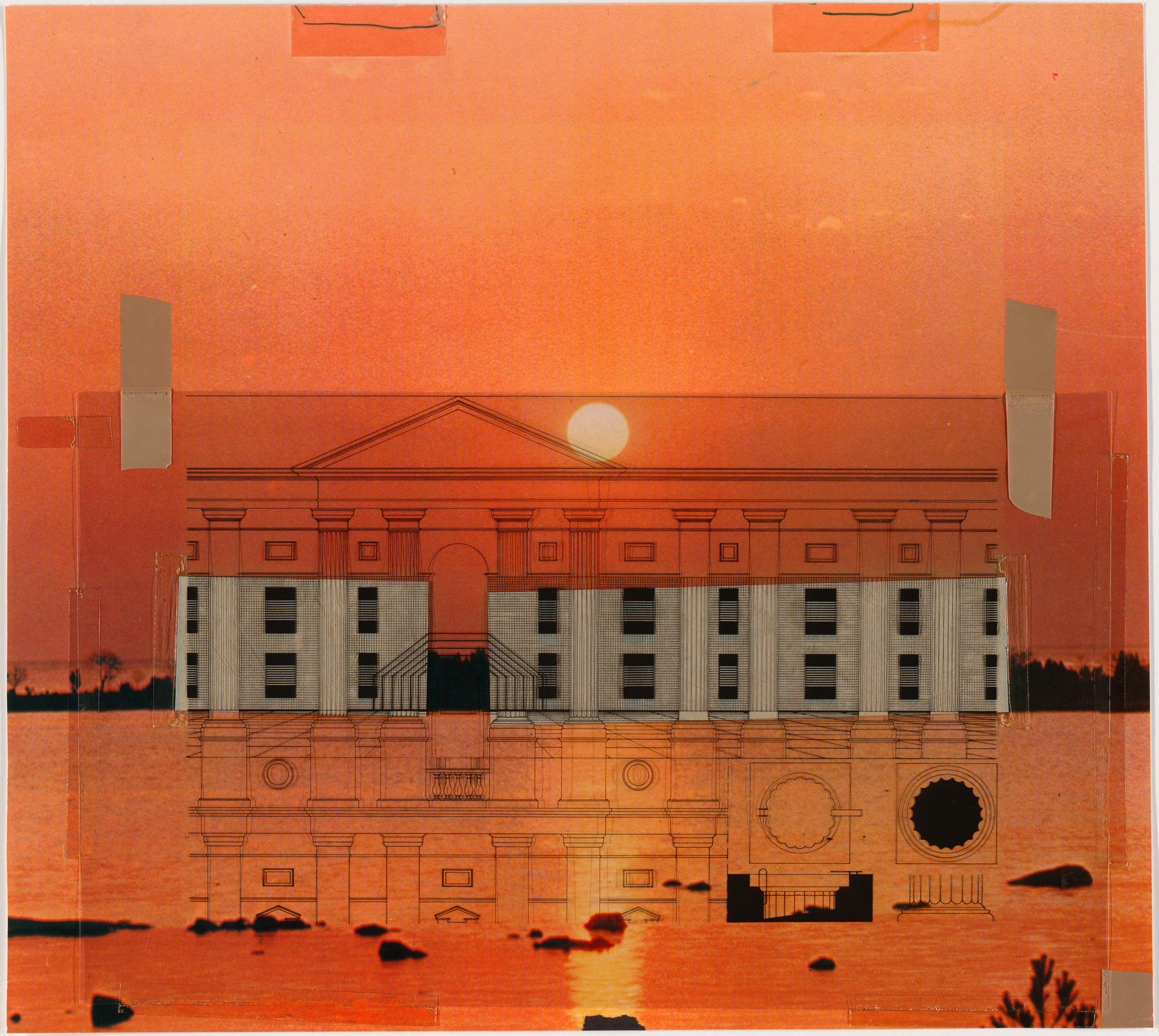
Alessandro Mendini. Housing. Project, 1971. Elevation. Printed polymer sheet with tape on lithograph, 20 × 22½" (50.8 × 57.2 cm)
Gaetano Pesce
Italian, 1939–2024
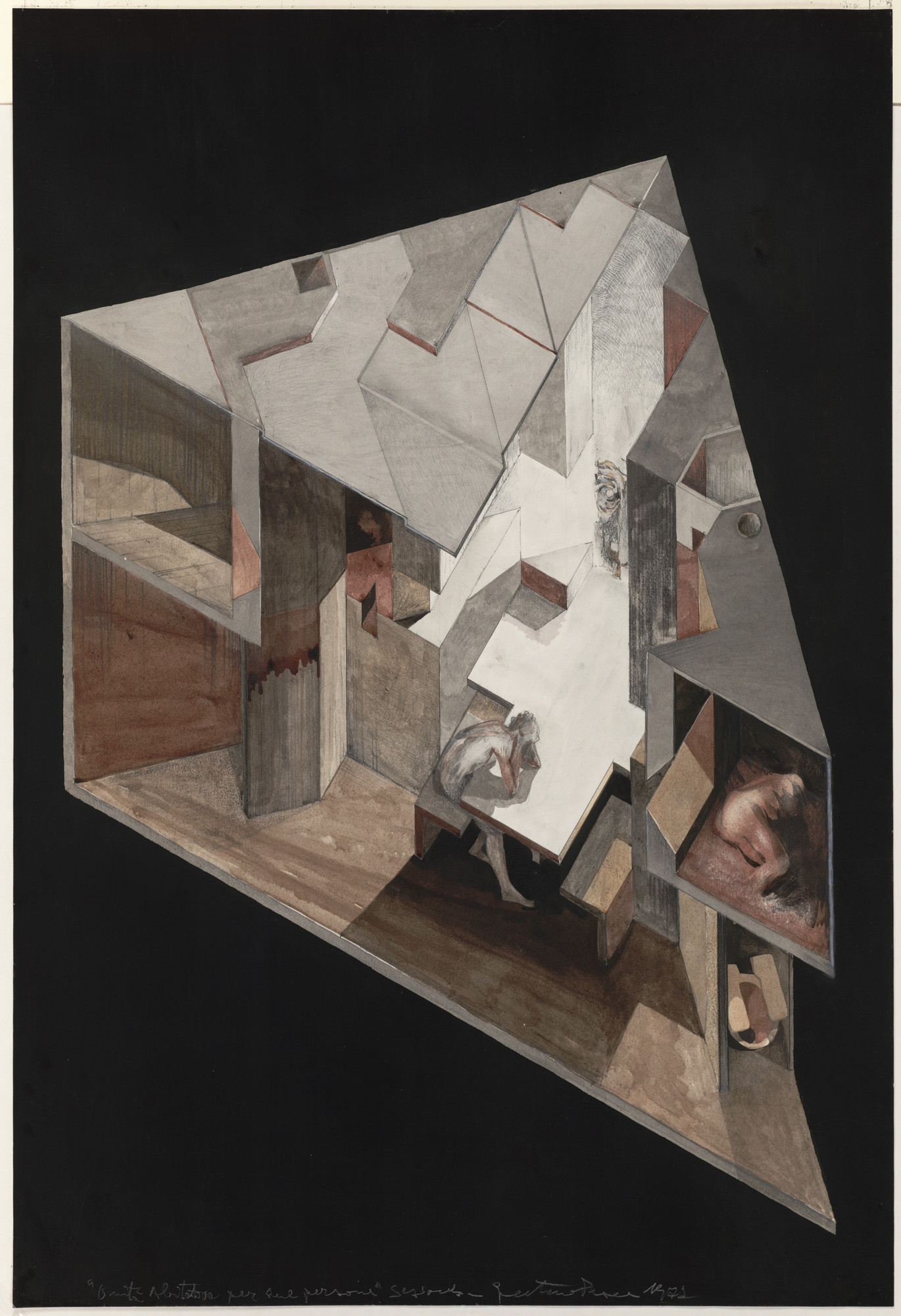
Gaetano Pesce. The Period of Great Contaminations: Housing Unit for Two People. Project, 1971–72. Axonometric section (1971). Goache, watercolor, and graphite with scoring on paper, 39¼ × 26¾" (99.7 × 67.9 cm)
Gaetano Pesce's drawings of the Period of Contaminations, Housing Unit for Two People, are two of a number of works designed for his installation in The Museum of Modern Art's 1972 exhibition Italy: The New Domestic Landscape. Pesce's work presented a third-millennium archeologist's discovery of an underground southern alpine city from a hundred years earlier. The drawings illustrate an age in which people have settled in various underground pockets, drained of mineral oils and water, and sealed off from the outside world by large stones. These "archeological remains" are meant to reflect on essential conditions for living, such as, "the exploitation of the interior of the planet," "the importance of space," "the necessity of isolation," and "noncommunication as characteristic of human life."
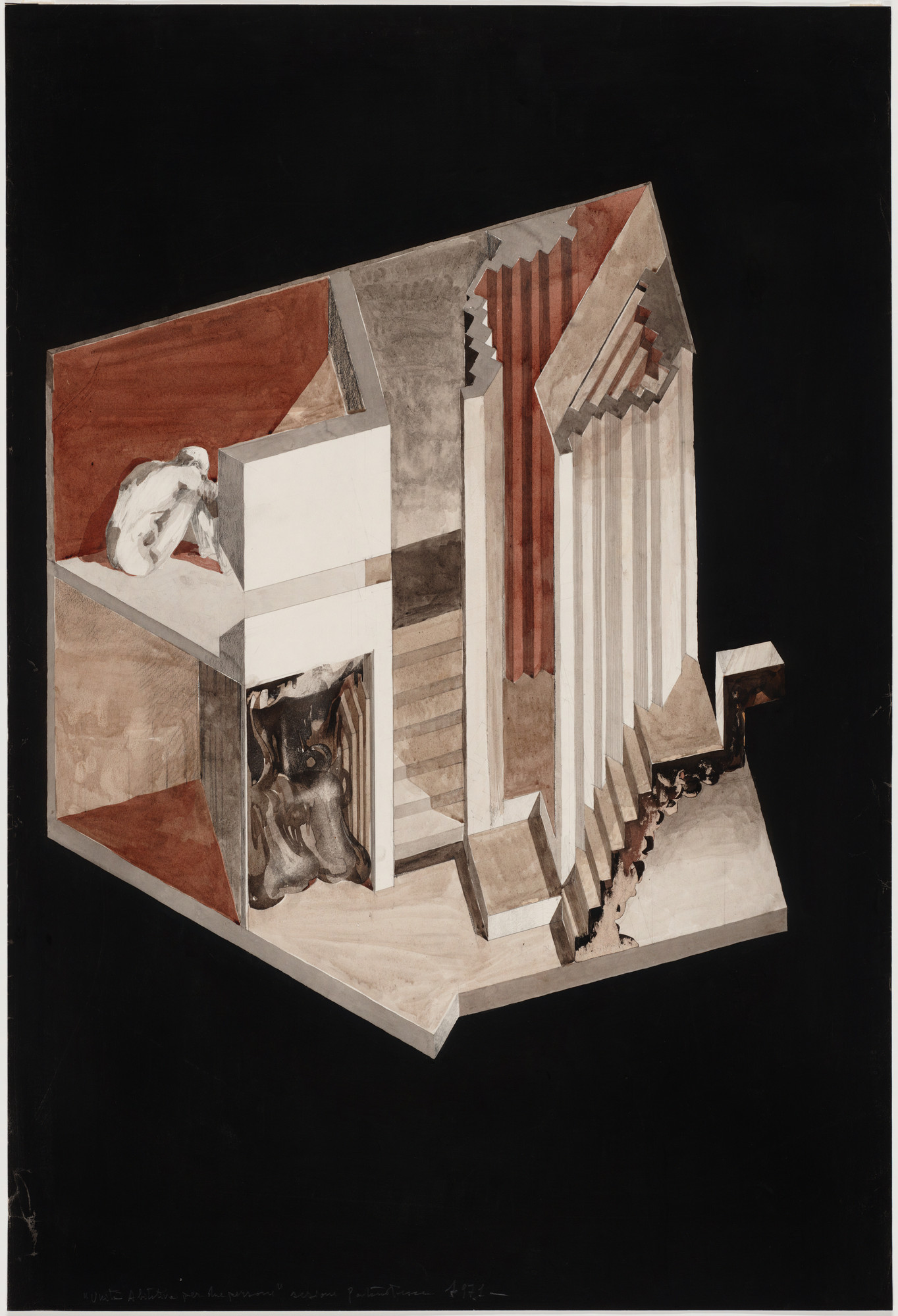
Gaetano Pesce. The Period of Great Contaminations: Housing Unit for Two People. Project, 1971–72. Axonometric section (1971). Goache, watercolor, and graphite with scoring on paper, 39⅜ × 26¾" (100 × 67.9 cm)
Aldo Rossi
Italian, 1931–1997
and Gianni Braghieri
Italian, born 1945
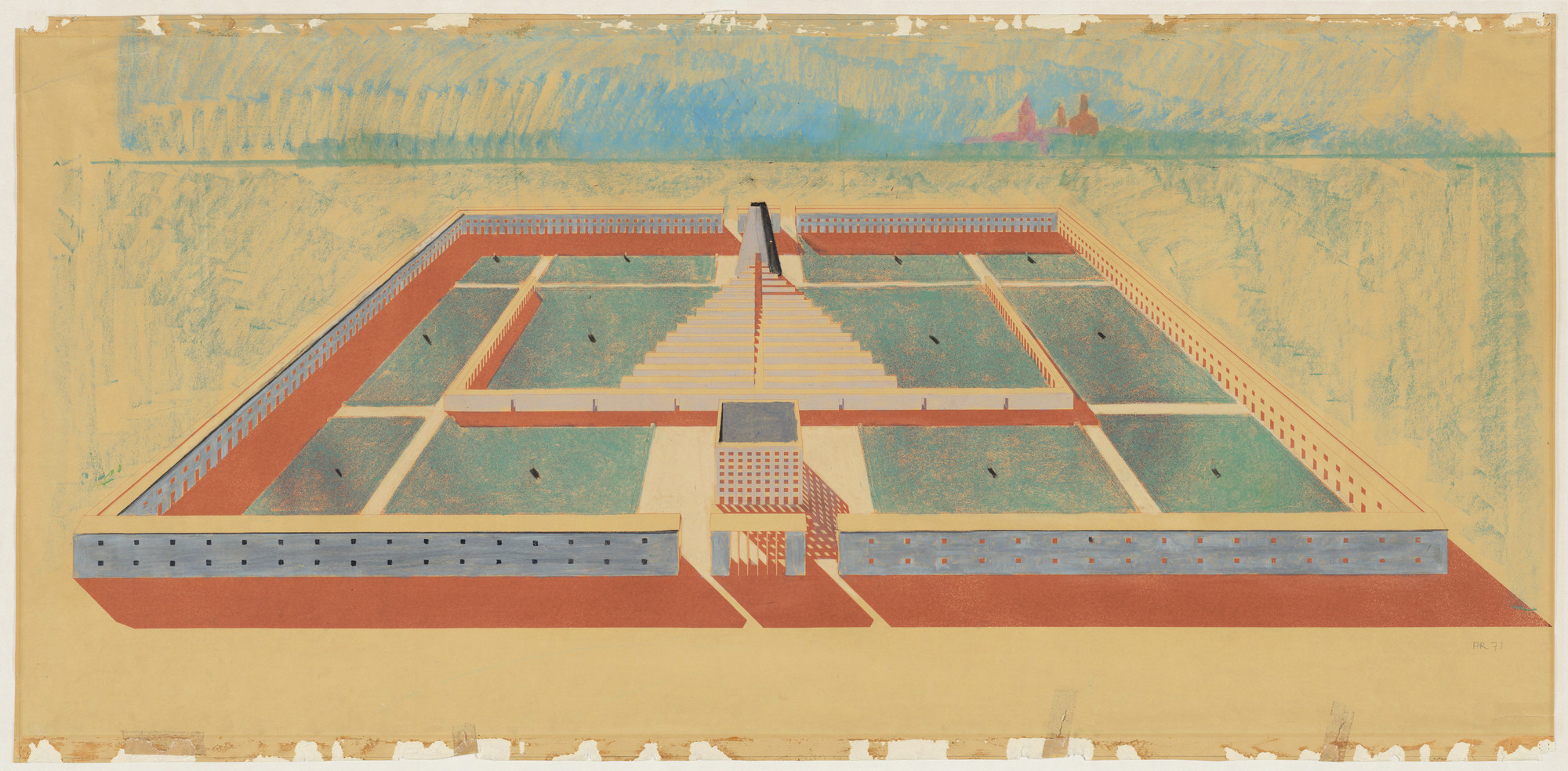
Aldo Rossi, Gianni Braghieri. Cemetery of San Cataldo, Modena, Italy. 1971–84. Aerial perspective (1971). Crayon and graphite on sepia diazotype, 24 × 49¾" (61 × 126.4 cm)
Aldo Rossi designed the Cemetery of San Cataldo for a 1971 competition that called for an extension to the existing nineteenth-century Costa Cemetery. Employing conventions of perspective developed in the fifteenth century, Rossi uses an aerial view to give a sense of the cemetery in both plan and elevation. One enters this wall-enclosed space through a gate opposite what seems to be an abandoned house, a cubic structure designed as a collective or nondenominational temple to be used for funeral, religious, or civil ceremonies. As one proceeds along the central axis, it passes through successive rectangular structures, riblike ossuaries that rise in height as they diminish in length. The journey is punctuated by a cone-shaped smokestack monumentalizing a communal grave for the unknown, and referencing the industrial landscape beyond. Rossi's design is rooted in an Enlightenment typology of the cemetery as a walled structure set on the outskirts of town. It not only recalls the adjacent Costa Cemetery but, as Rossi says, "complies with the image of a cemetery that everyone has." A structure without a roof, it is a deserted building intended for those who no longer need the protection of shelter-a house for the dead in which life and death exist as a continuum within the collective memory.
Through his use of aerial perspective, elemental form, and color, Rossi constructs a visual passage through the drawing that corresponds to the journey contra natura through the cemetery. Shadows stem from a particular light source yet reference no particular time of day. Perspective, traditionally universalizing, is colored with a Northern Italian palette, and draws our eye not back into space but rather up the page. Like the cemetery itself, the drawing presents a road toward abandonment in which time seems to stand still.
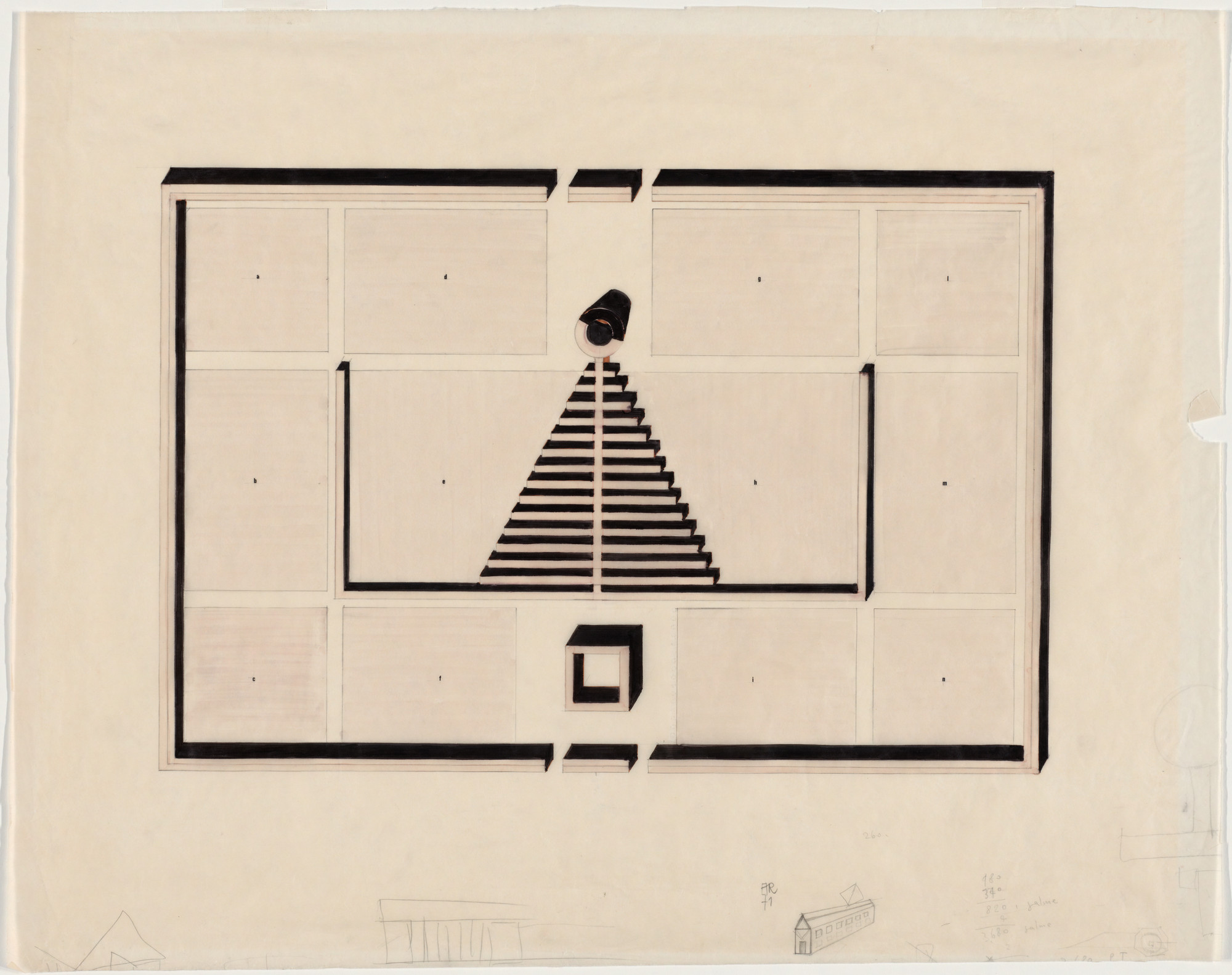
Aldo Rossi, Gianni Braghieri. Cemetery of San Cataldo, Modena, Italy. 1971–84. Plan (1971). Ink, color ink, and graphite on tracing paper, 23½ × 29¾" (59.7 × 75.6 cm)
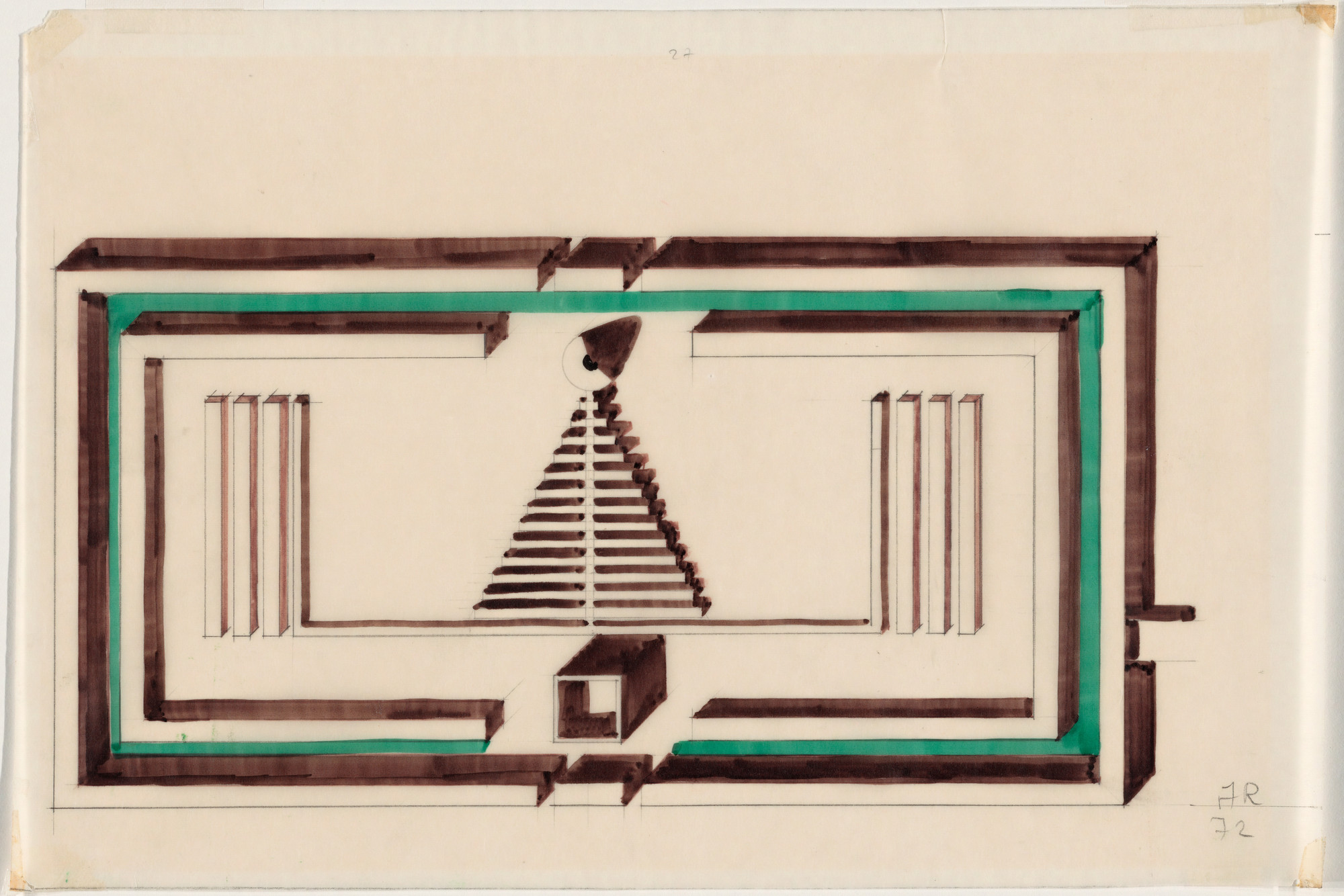
Aldo Rossi, Gianni Braghieri. Cemetery of San Cataldo, Modena, Italy. 1971–84. Plan study (1972). Color ink and graphite on tracing paper, 10 × 14¾" (25.4 × 37.5 cm)
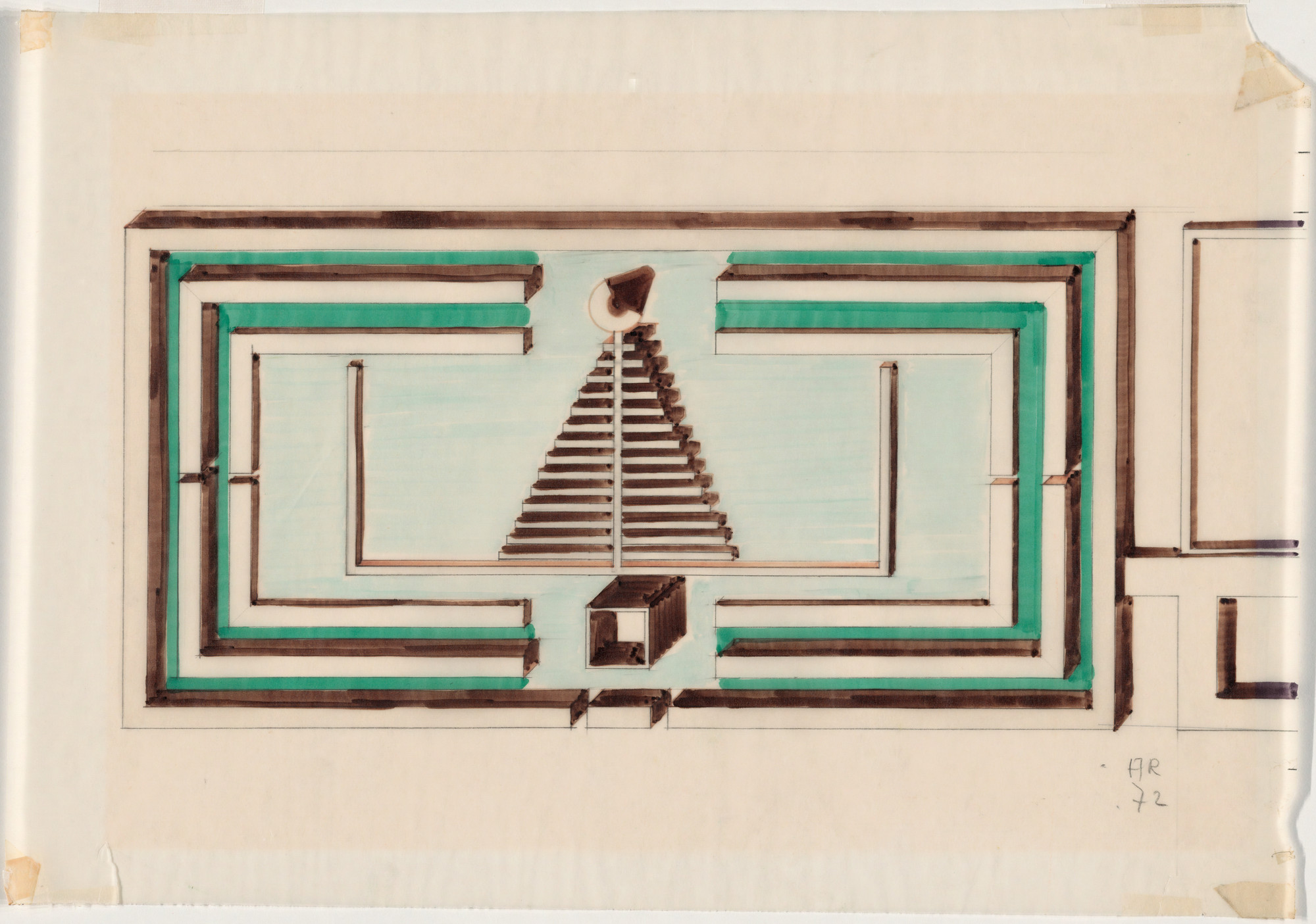
Aldo Rossi, Gianni Braghieri. Cemetery of San Cataldo, Modena, Italy. 1971–84. Plan study (1972). Color ink and graphite on tracing paper, 11 × 15¾" (27.9 × 40 cm)
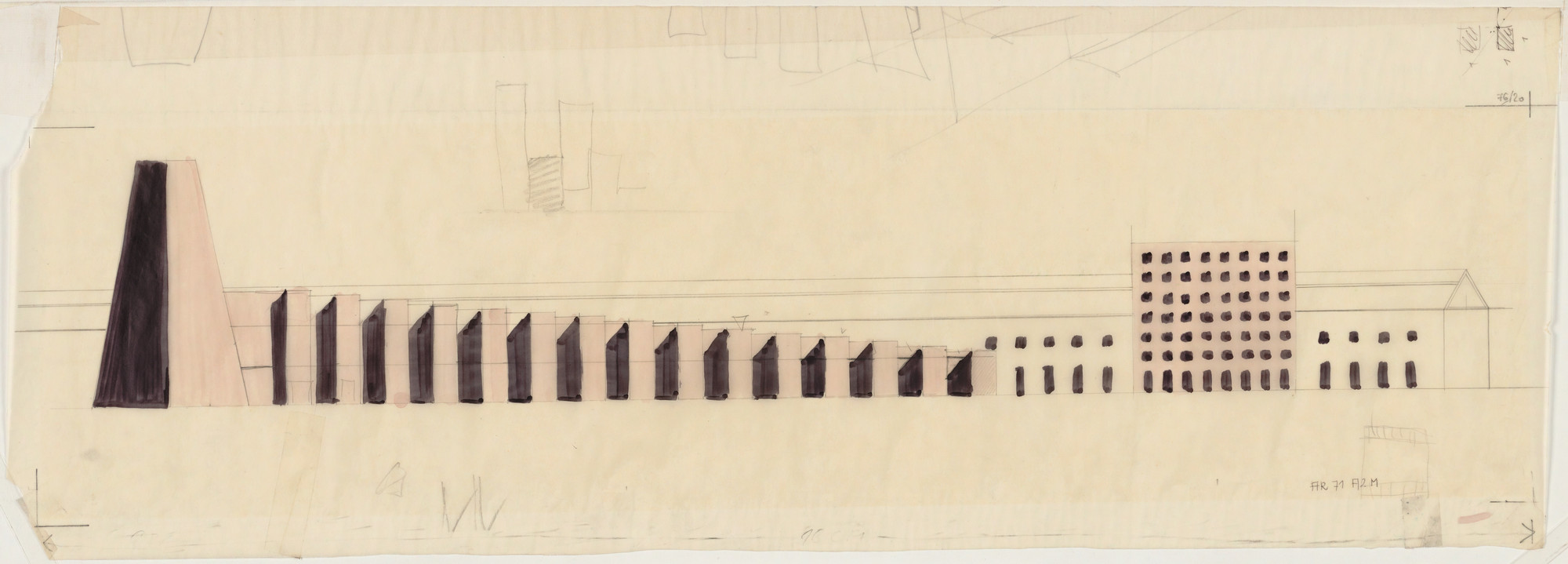
Aldo Rossi, Gianni Braghieri. Cemetery of San Cataldo, Modena, Italy. 1971–84. Elevation study (1971). Ink and graphite on tracing paper, 11 × 30⅝" (27.9 × 77.8 cm)
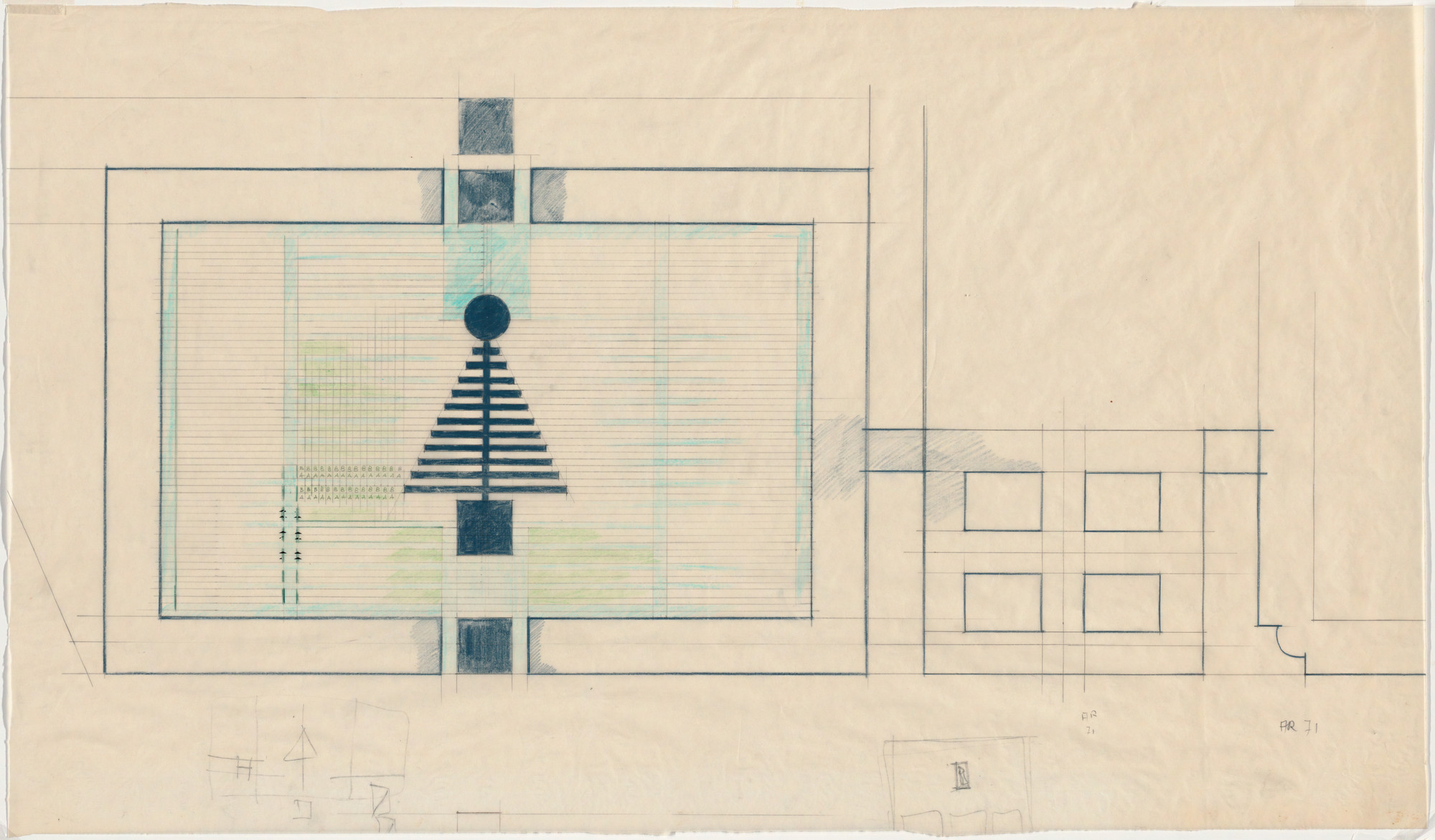
Aldo Rossi, Gianni Braghieri. Cemetery of San Cataldo, Modena, Italy. 1971–84. Plan study (1971). Graphite, colored pencil, and dry transfer film on tracing paper, 23½ × 40¼" (59.7 × 102.2 cm)
Raimund Abraham
American, born Austria. 1933–2010

Raimund Abraham. The House with Curtains. Project, 1972. Perspective. Crayon and graphite on paper, 36⅛ × 56¾" (92.1 × 144.1 cm)
In the early 1970s Raimund Abraham's renewed interest in the typology of the house resulted in numerous projects exploring the ritual of dwelling. To explore the various psychological conditions intuited in the archetypal house, Abraham used words as well as images. In a poem he titled "Elements of the House," he indicated often opposing sensations and feelings, natural elements and cycles, and spatial components to characterize his subject. With regard to the design for a House with Curtains, the open grid with blowing curtain walls gives physical form to "the wind," "movement," "transparencies," and "dreams." In the House without Rooms, what looks like the carved interior of a boulder embodies, "density," "paralysis," "isolation," and "wombs." Situated in barren landscapes, either imagined or from memory, both schemes are for houses that straddle the earth and the sky, and evoke life's oppositions.

Raimund Abraham. The House without Rooms. Project, 1974–75. Elevation and plan (1974). Color pencil, graphite, and cut-and-pasted printed paper on paper, 34⅝ × 38⅛" (87.9 × 96.8 cm)
Léon Krier
Luxembourger, born 1946
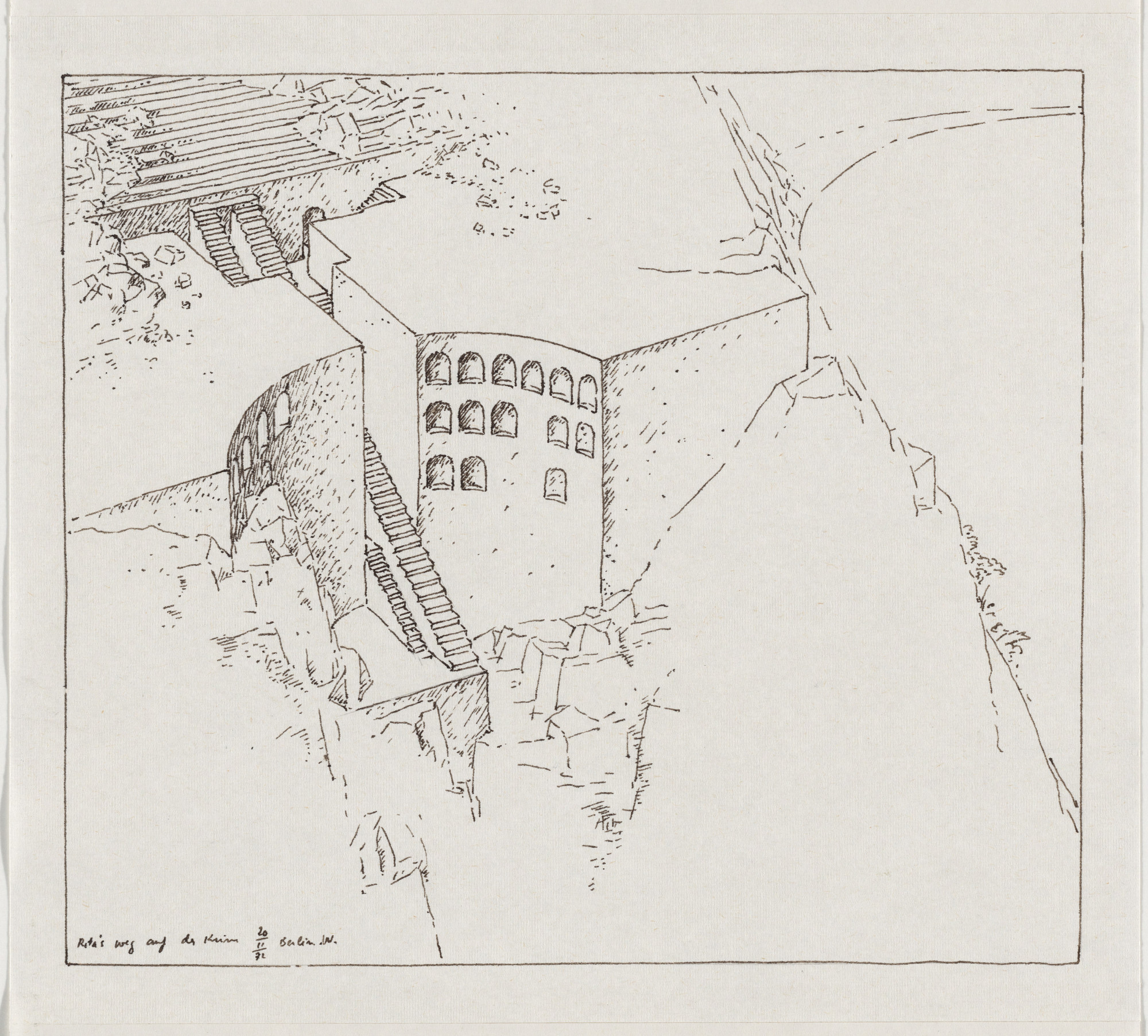
Léon Krier. House without Rooms. Project, 1972. Aerial perspective. Ink on paper, 11¾ × 8¼" (29.8 x 21 cm)
John Hejduk
American, 1929–2000
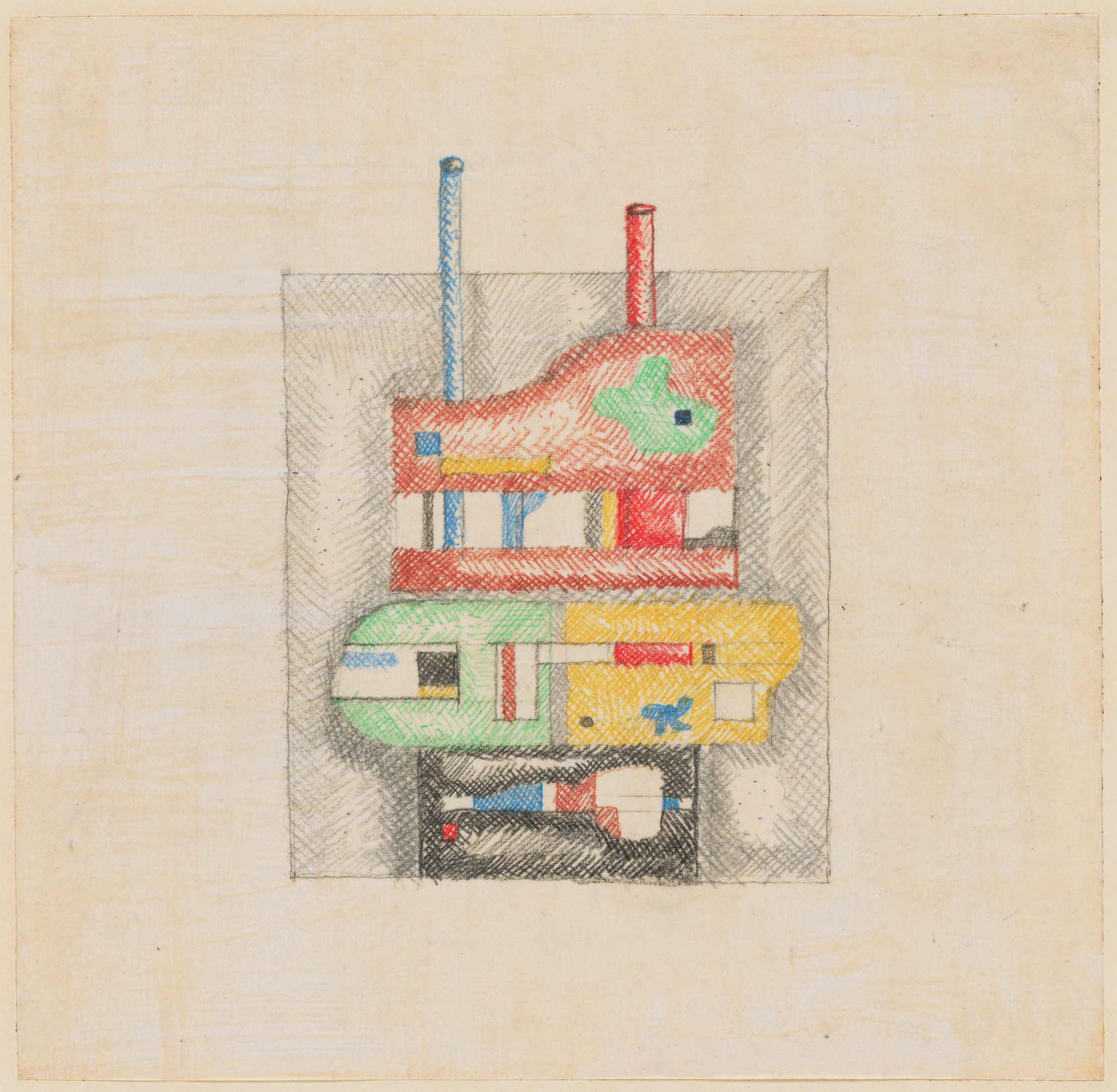
John Hejduk. Wall House 2 (A. E. Bye House), Ridgefield, Connecticut. Project, 1973–76. Combined elevation and plan (1973): color pencil and graphite on tracing paper on board, 8 × 8⅛" (20.3 × 20.6 cm)
Wall House 2 (A. E. Bye House) is the second in a series of visionary projects that John Hejduk began in the mid-1960s to explore what he deemed the first principles of architecture. As with the first in the series, he used the wall to reinterpret the traditional configuration of the house in his design for the landscape architect Arthur Edward Bye. Each functional component (or room) is isolated from every other one, and all but one (the study) are stacked adjacent to the same wall. Thus, the wall becomes a dividing element, which must be passed through on leaving or entering a room, as well as a unifying element, which binds them. The separate function of each room is reinforced by its color: green reflects the nourishment of dining, yellow the energy of cooking, and gray the realm of reflection. Originally designed in 1973–76 for a site in Connecticut, the Bye House was eventually built in Gröningen, the Netherlands, in 2001.
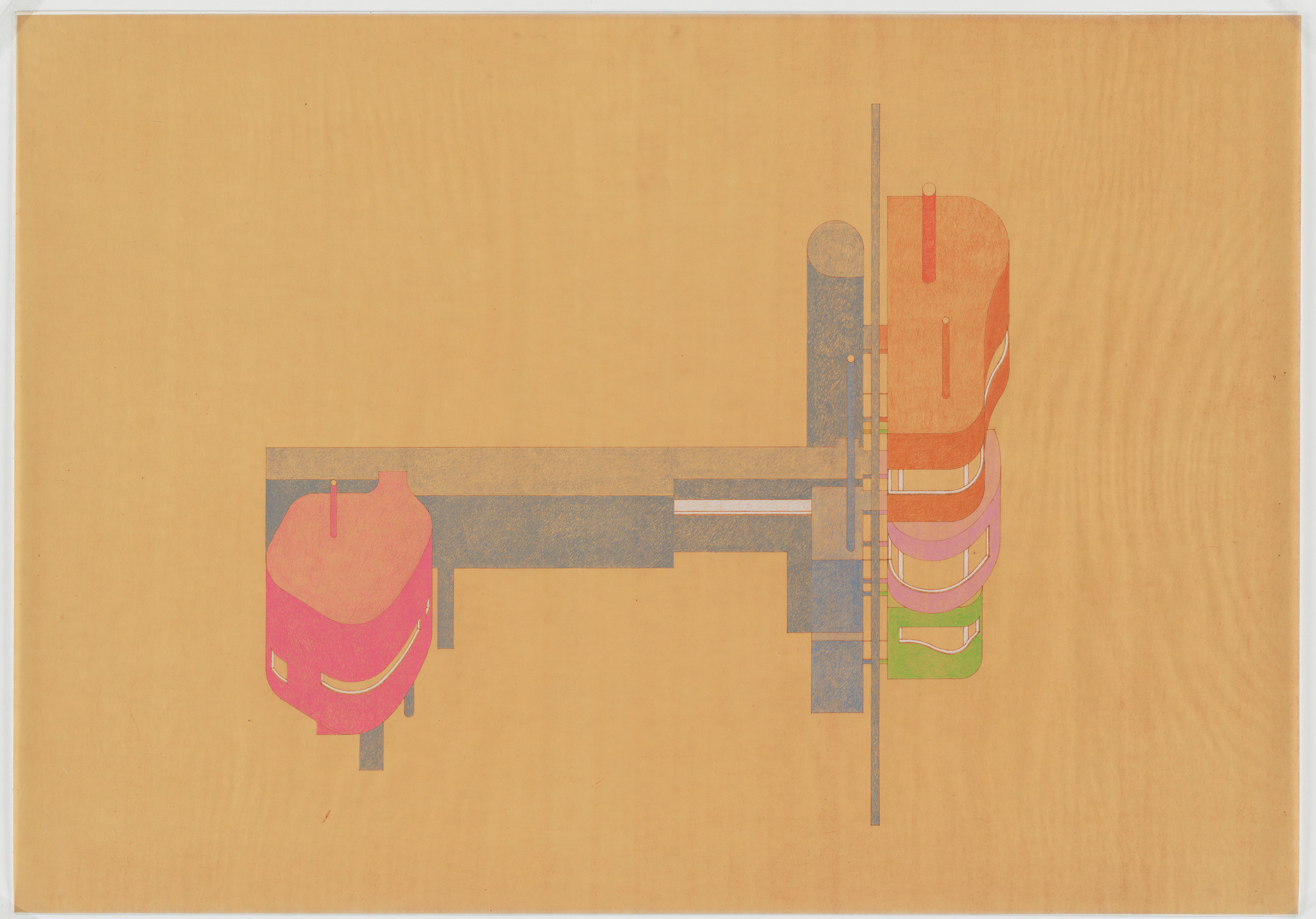
John Hejduk. Wall House 2 (A. E. Bye House), Ridgefield, Connecticut. Project, 1973–76. Isometric (1973): crayon on sepia diazotype, 28 × 40⅛" (71 × 102 cm)
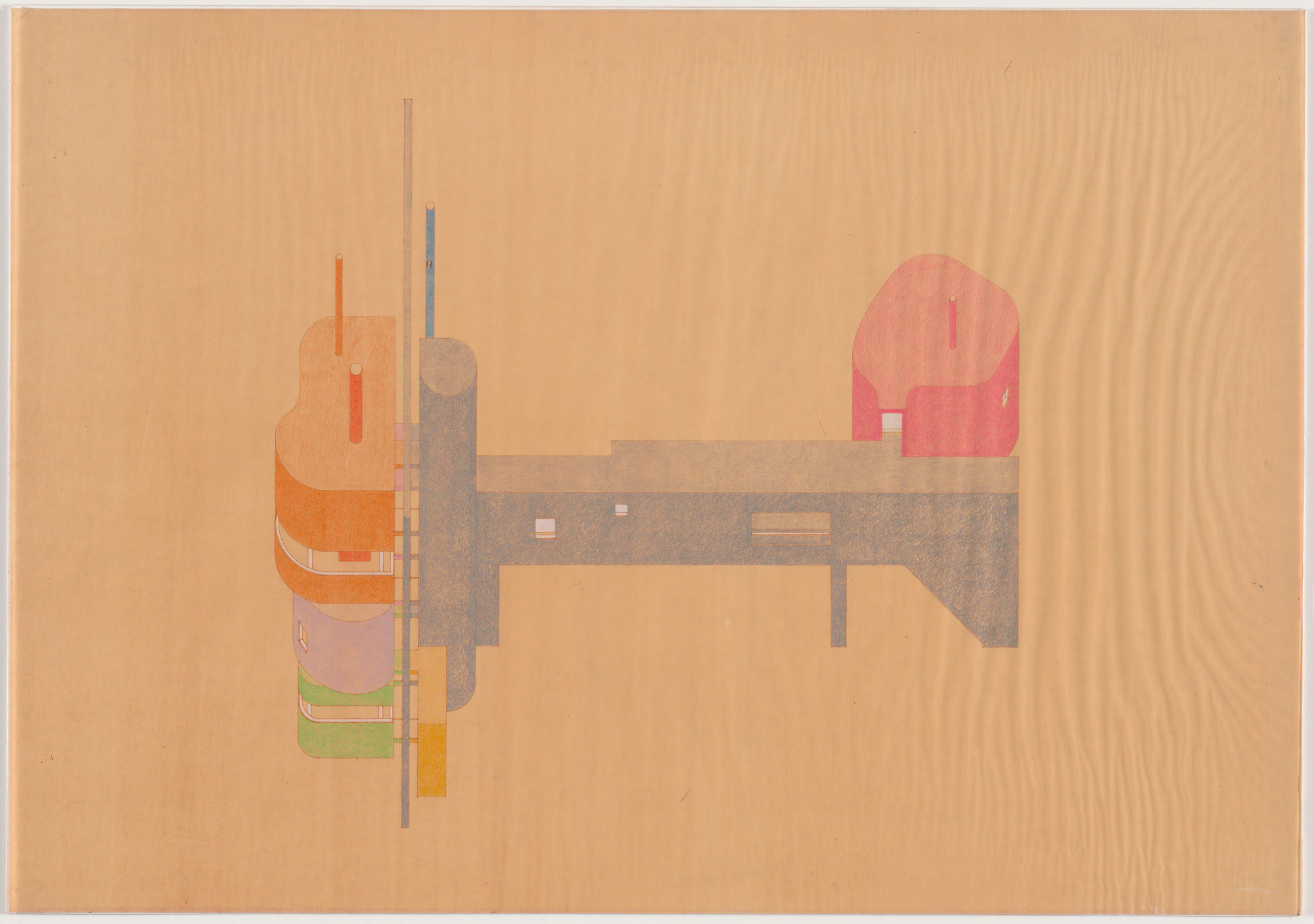
John Hejduk. Wall House 2 (A. E. Bye House), Ridgefield, Connecticut. Project, 1973–76. Isometric (1973): crayon on sepia diazotype, 28 × 40⅛" (71 × 102 cm)
Rem Koolhaas
Dutch, born 1944
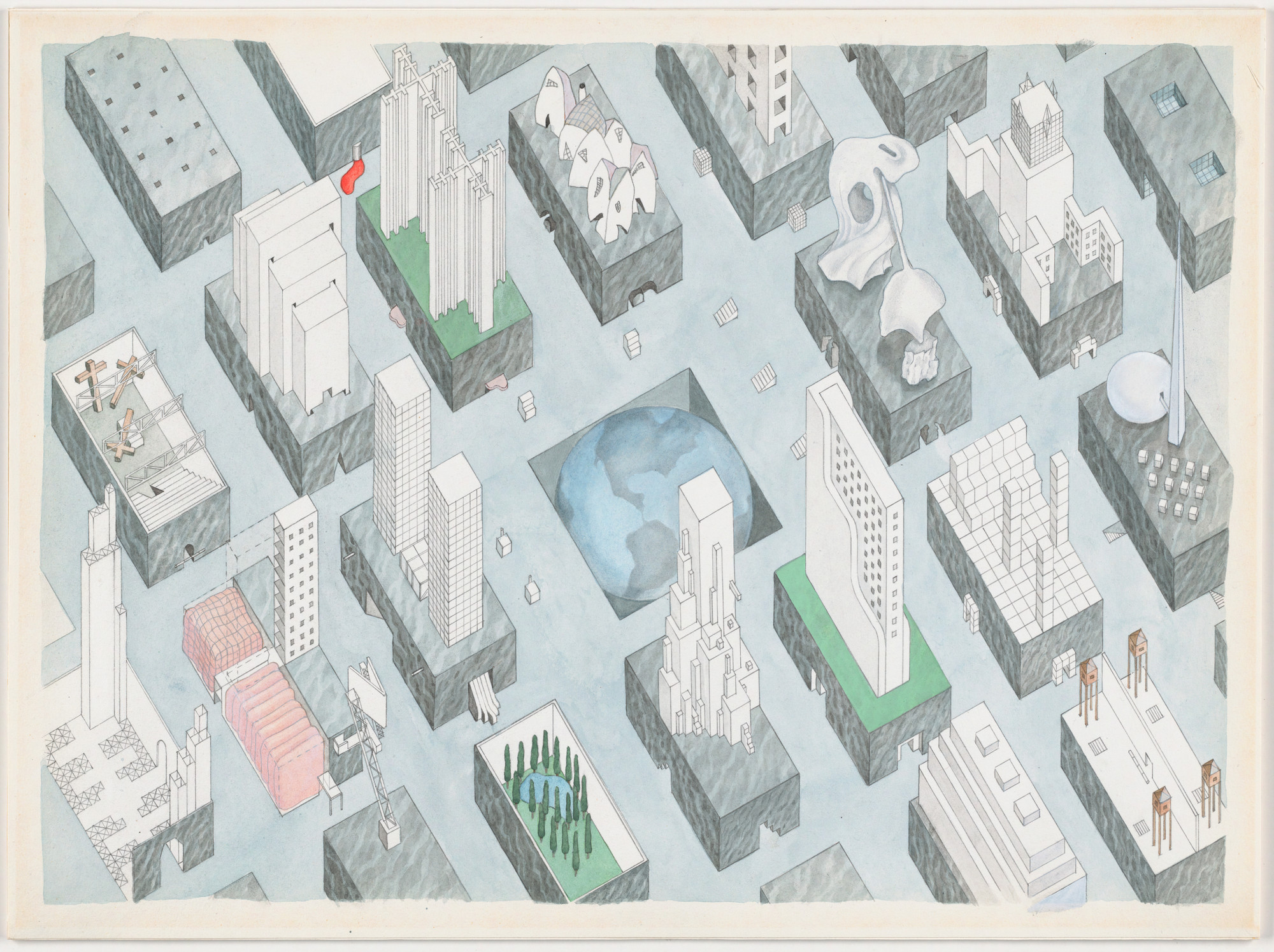
Rem Koolhaas, Madelon Vriesendorp. The City of the Captive Globe, New York, New York. Project, 1972. Axonometric: gouache and graphite on paper, 12½ × 17⅜" (31.8 × 44.1 cm)
The City of the Captive Globe is a rendering of Rem Koolhaas's intuitive approximation of the architecture of Manhattan. This drawing, according to the architect, celebrates Manhattan's "culture of congestion," presenting a relentless grid as Manhattan's overriding characteristic. Within this scheme, each city block is designated to embody a different value or philosophy, among these are many avant-garde movements previously thought of as incompatible. Each block, which is itself a city, is surmounted by a structure that represents its function or identity, for example, El Lissitzky's Lenin's Stand, Le Corbusier's Plan Voisin, or Wallace Harrison's Trylon and Perisphere for the 1939 New York World's Fair. Koolhaas's metaphor proposes an urban model in which unity accommodates heterogeneity.
Max Peintner
Austrian, born 1937
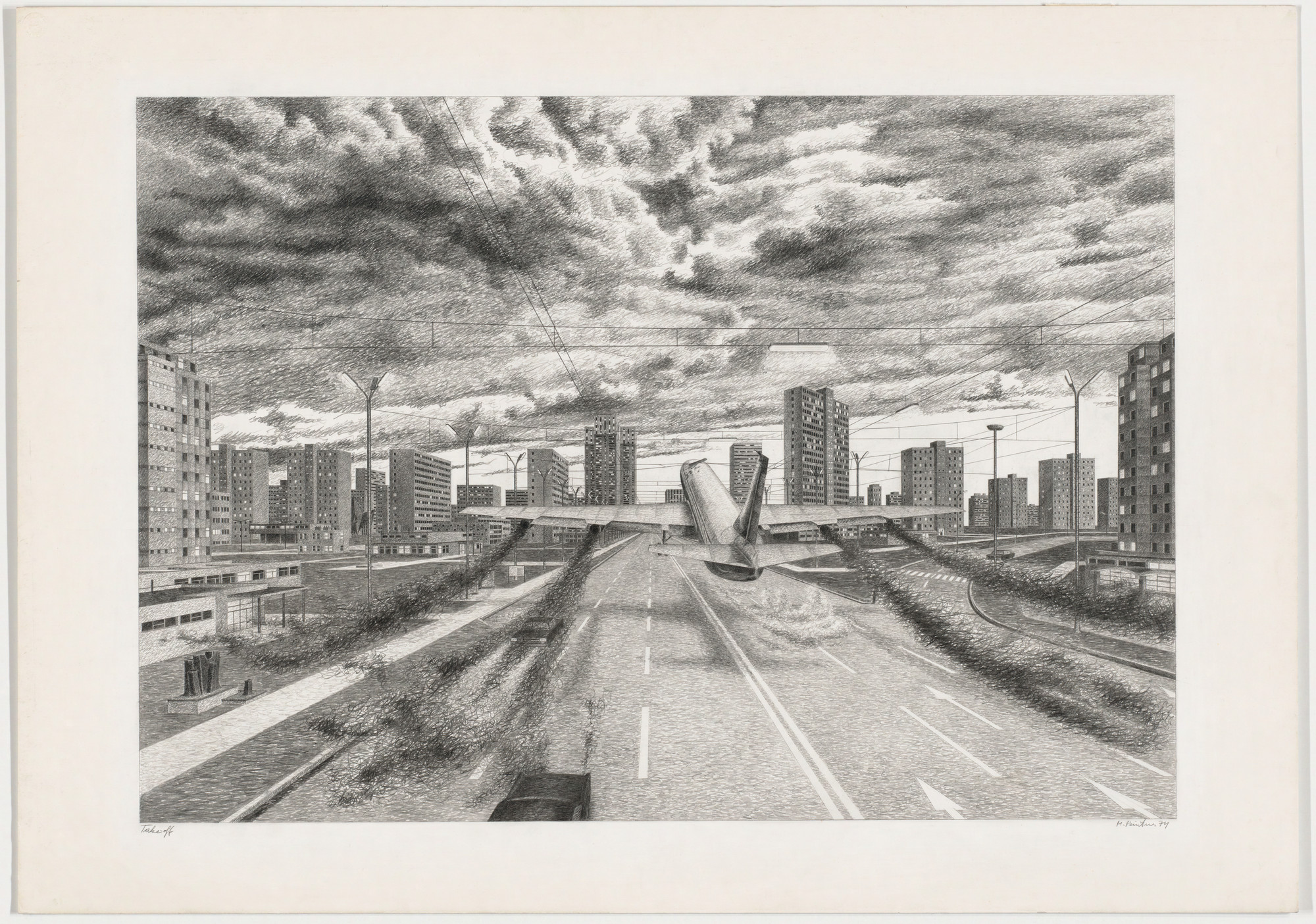
Max Peintner. Take-Off. Project, 1974. Perspective. Pencil on paper, 24½ × 34⅝" (62.2 × 87.9 cm)
Massimo Scolari
Italian, born 1943
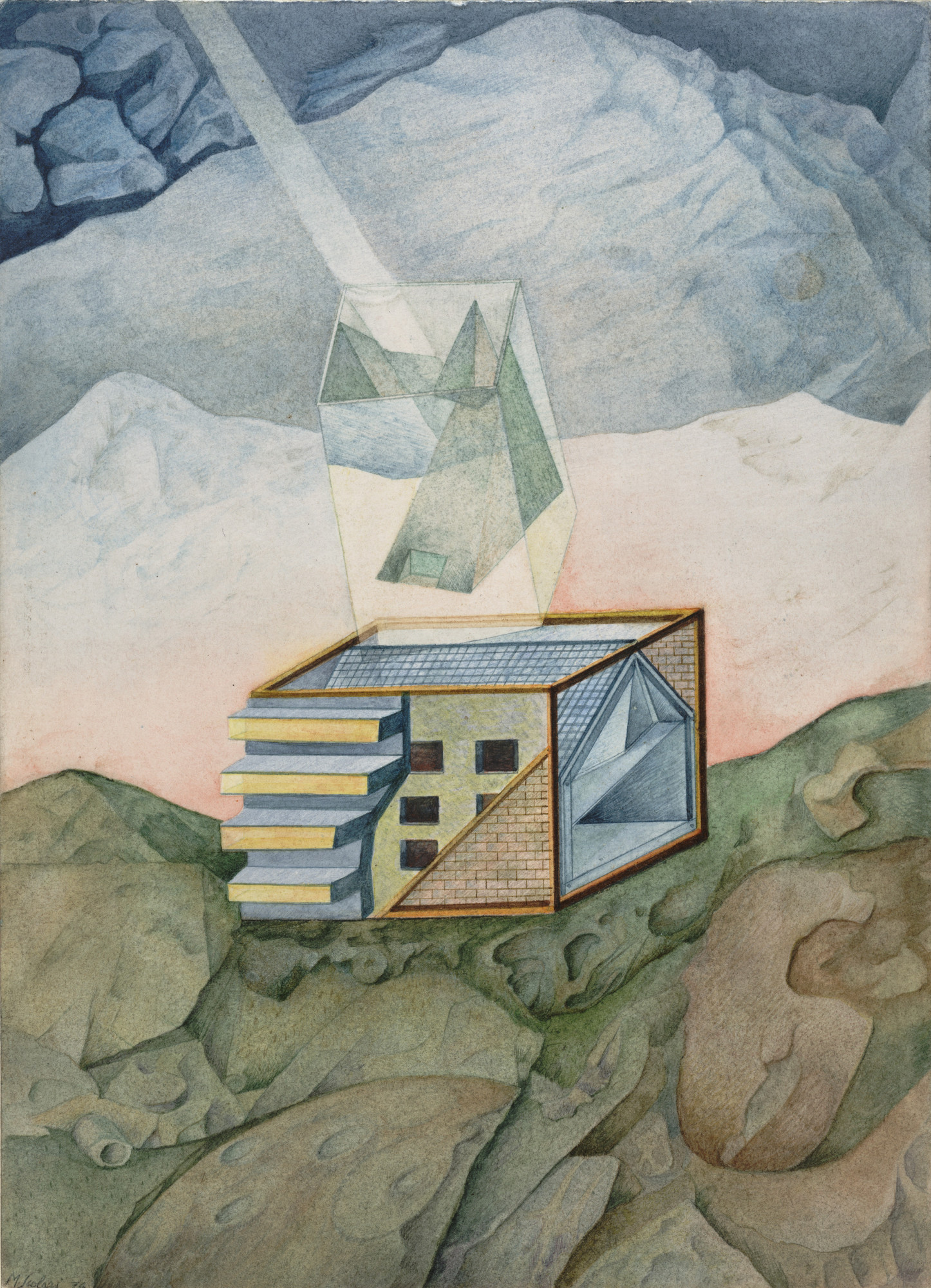
Massimo Scolari. Urban Passage. Project, 1974. Axonometric. Colored ink and watercolor on board, 7⅛ × 5⅛" (18.1 × 13 cm)
Massimo Scolari used images to manipulate form without using Renaissance or neoclassical styles. His drawings are pure fantasy and often defy explanation. In Urban Passage, geometric forms resembling a house seem to be projected onto a mythical landscape by the sky. In Addio Melampo, these forms emanate from the earth itself. Its title refers both to the name of a dog in an Italian novel and to a mythical Greek man who can see the future and understand the voices of animals, although for Scolari there is not necessarily a connection between the title and the image of a drawing. Addio Melampo is clearly a drawing born from imagination.
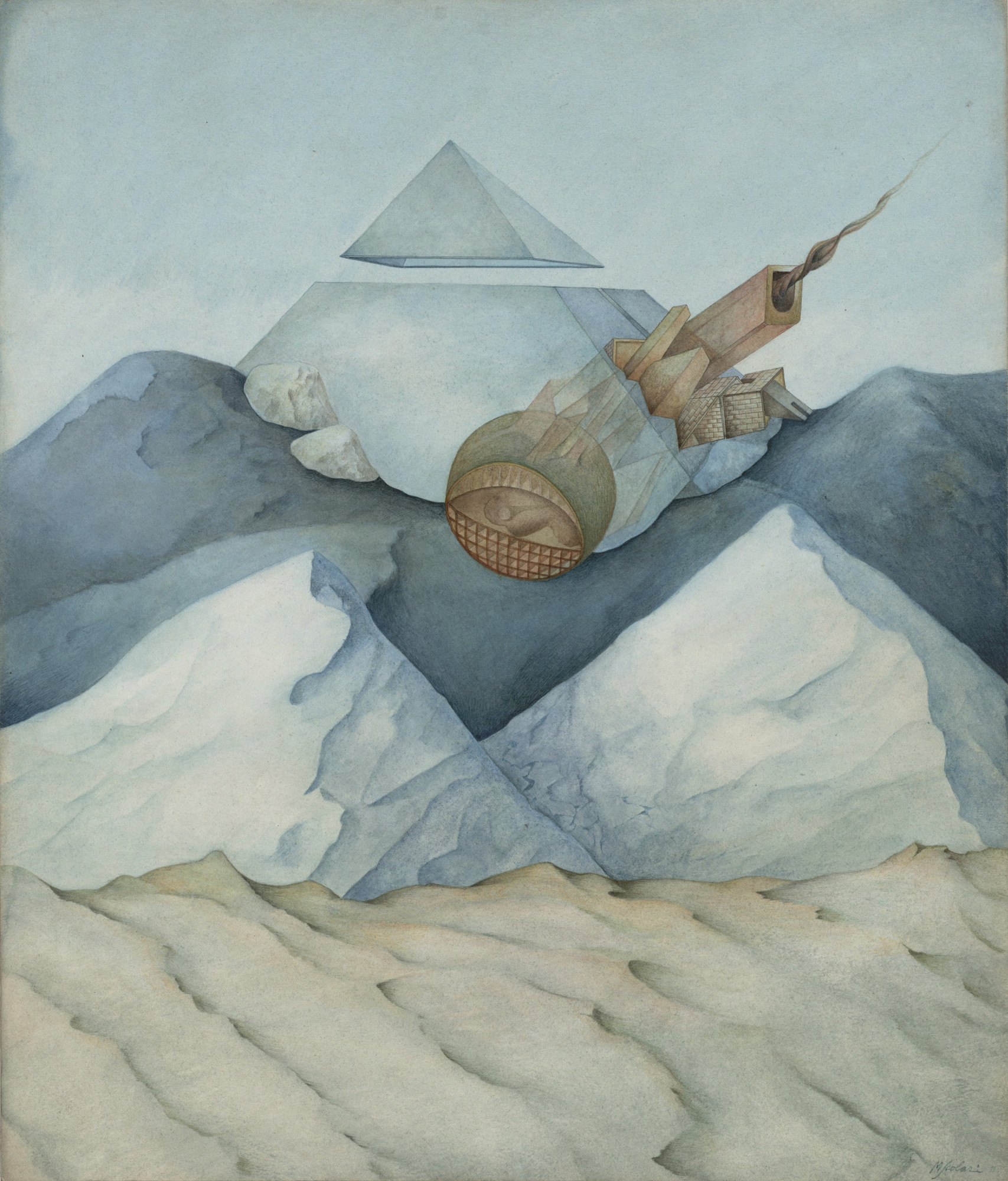
Massimo Scolari. Addio Melampo. Project, 1975. Oblique projection. Colored ink, watercolor, and graphite on board. 11⅞ × 10" (30.2 × 25.4 cm)
Emilio Ambasz
Argentine, born 1943
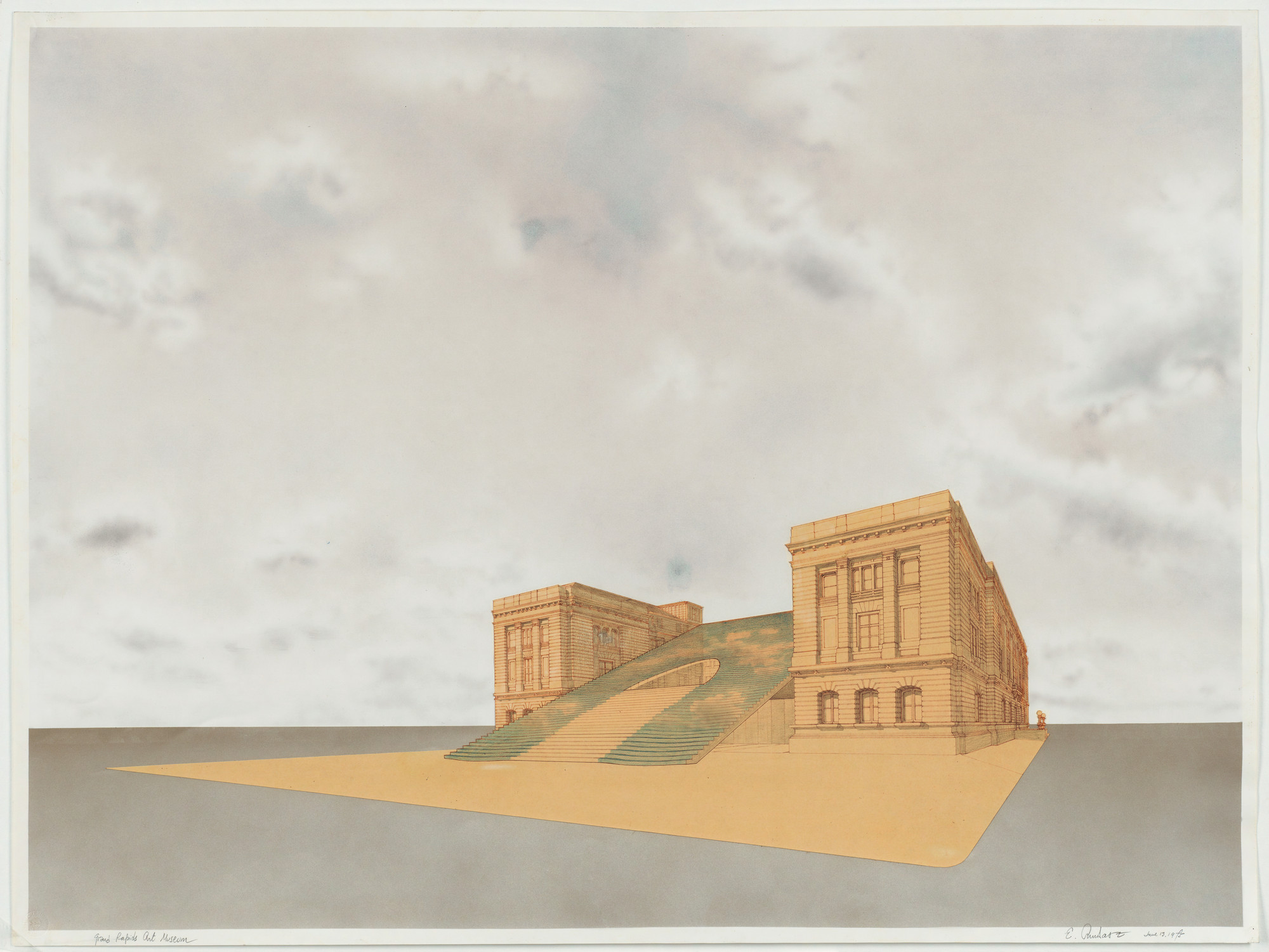
Emilio Ambasz. Grand Rapids Art Museum, Grand Rapids, Michigan. Project, 1975. Perspective. Cut-and-pasted sepia diazotype with color crayon on paper and airbrush, 30 × 40" (76.2 × 101.6 cm)
Emilio Ambasz's design for the Grand Rapids Art Museum proposed to transform an existing 1908 Beaux-Arts post office into the museum's new headquarters. The intention was to revitalize the Grand Rapids downtown area by using this vacant federal building in conjunction with additional underused or abandoned structures. Ambasz left the existing structure intact; his only intervention was to move the entrance to the open courtyard, thereby creating a single entry for the museum and reintegrating the building with a nearby college and commercial downtown area. The entrance to the grand foyer is created by means of an inclined plane flanked by two stairways, which creates a ceremonial entrance as well as a covered courtyard. Similar inclined entrances were to be used in the additional structures. Although it had been commissioned by the museum, the design was never realized owing to financial difficulties.
Friedrich St. Florian
American, born Austria 1932
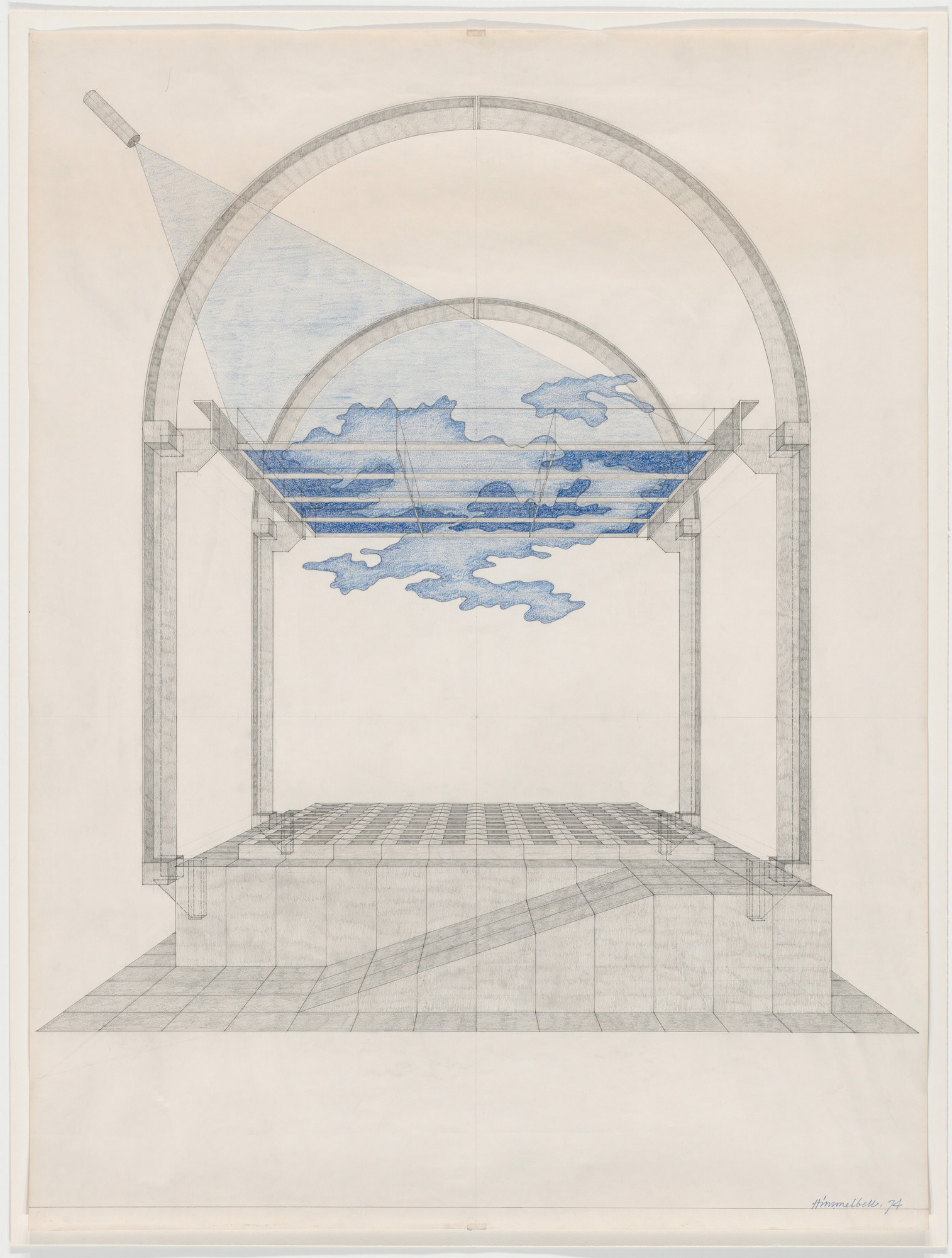
Friedrich St. Florian. Himmelbelt. Project, 1974. Perspective. Graphite and color pencil on paper, 47½ × 35¾" (120.6 × 90.8 cm)
Friedrich St. Florian undertook the theoretical Himmelbett project during a period in which he oscillated between embracing and rejecting built form, and explored the juxtaposition between real physical space and the imaginary realm of dreams. In this drawing, a holographic projection of the sky, or heaven, hovers above what St. Florian described as a classic bed, constructed from the essential building blocks of steel and stone. The green marble floor was to have a high polish in order to reflect the sky above. This would, in effect, allow the inhabitant to float somewhere between heaven and earth, as if taking a "walk into the sky."
Peter Eisenman
American, born 1932
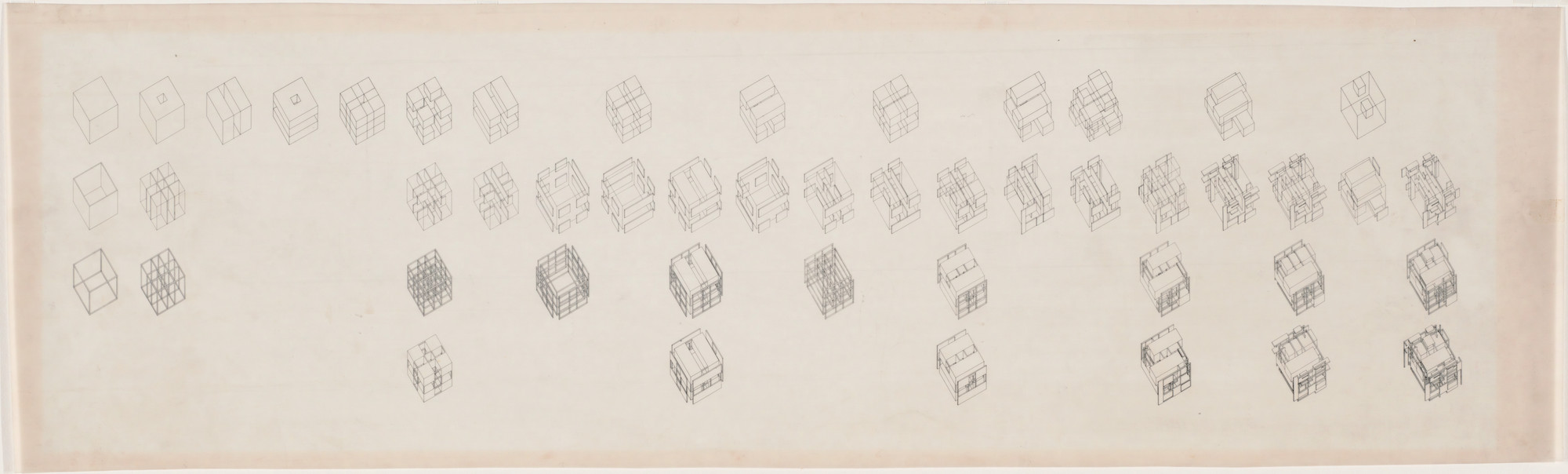
Peter Eisenman. House IV, Falls Village, Connecticut. Project, 1975. Axonometrics. Ink on frosted polymer sheet, 14 × 46¾" (35.6 × 118.7 cm)
Peter Eisenman designed eleven houses between the late 1960s and the 1970s that explore the principles of autonomous architecture. In the drawing for House IV, designed for a site in Falls Village, Connecticut, but never realized, a sequence of axonometrics illustrates the transformation of a basic cube into a highly developed spatial configuration. Based on a generative rule system, in which each move is a response to the last, the cube is cut, extended, and rotated until the final form is achieved without regard to function and program.
Léon Krier
Luxembourger, born 1946
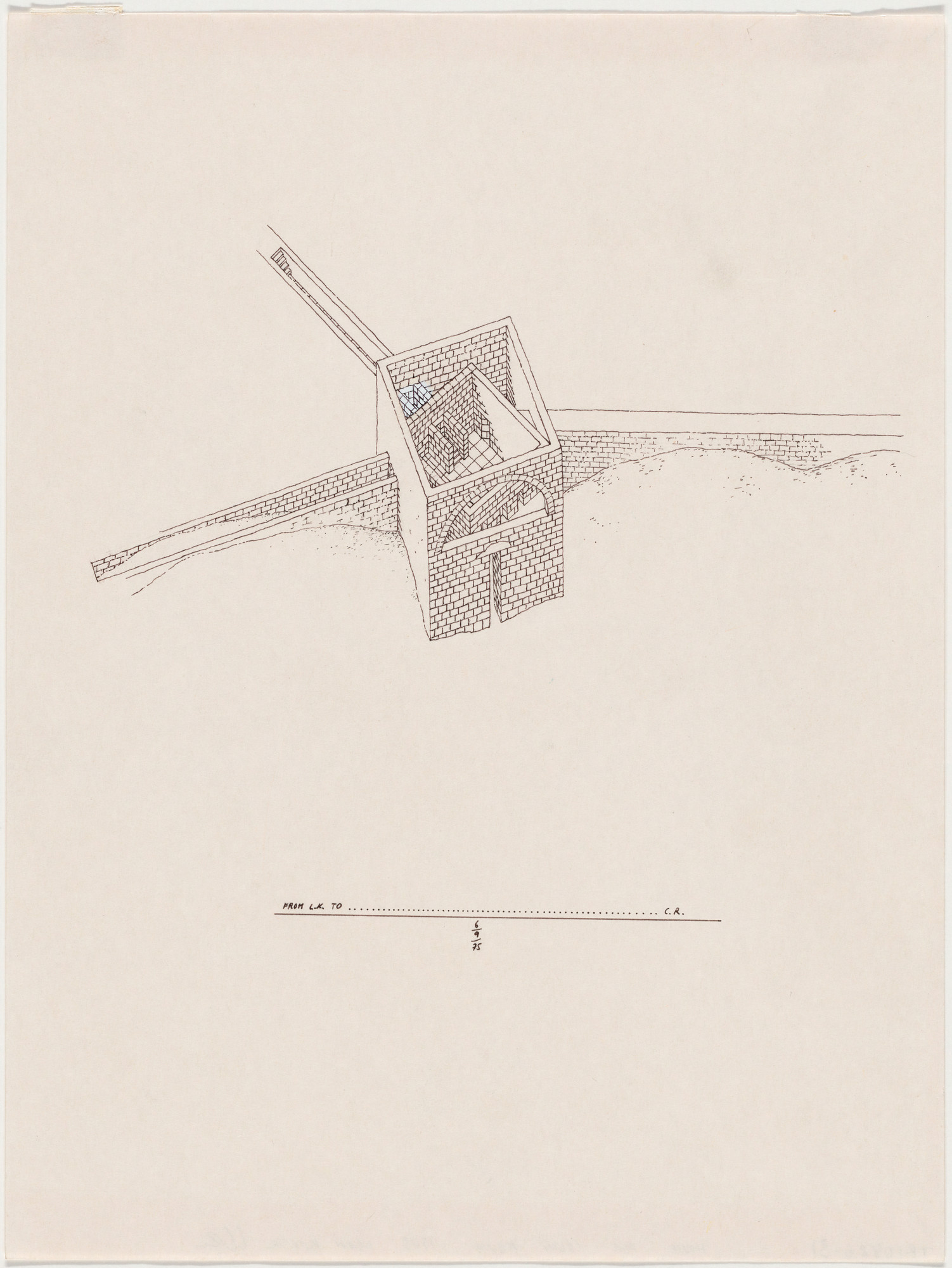
Leon Krier. House for Colin Rowe. Project, 1975. Aerial axonometric view. Ink with gouache on paper, 11 × 8¼" (27.9 × 21 cm)
Gaetano Pesce
Italian, 1939–2024
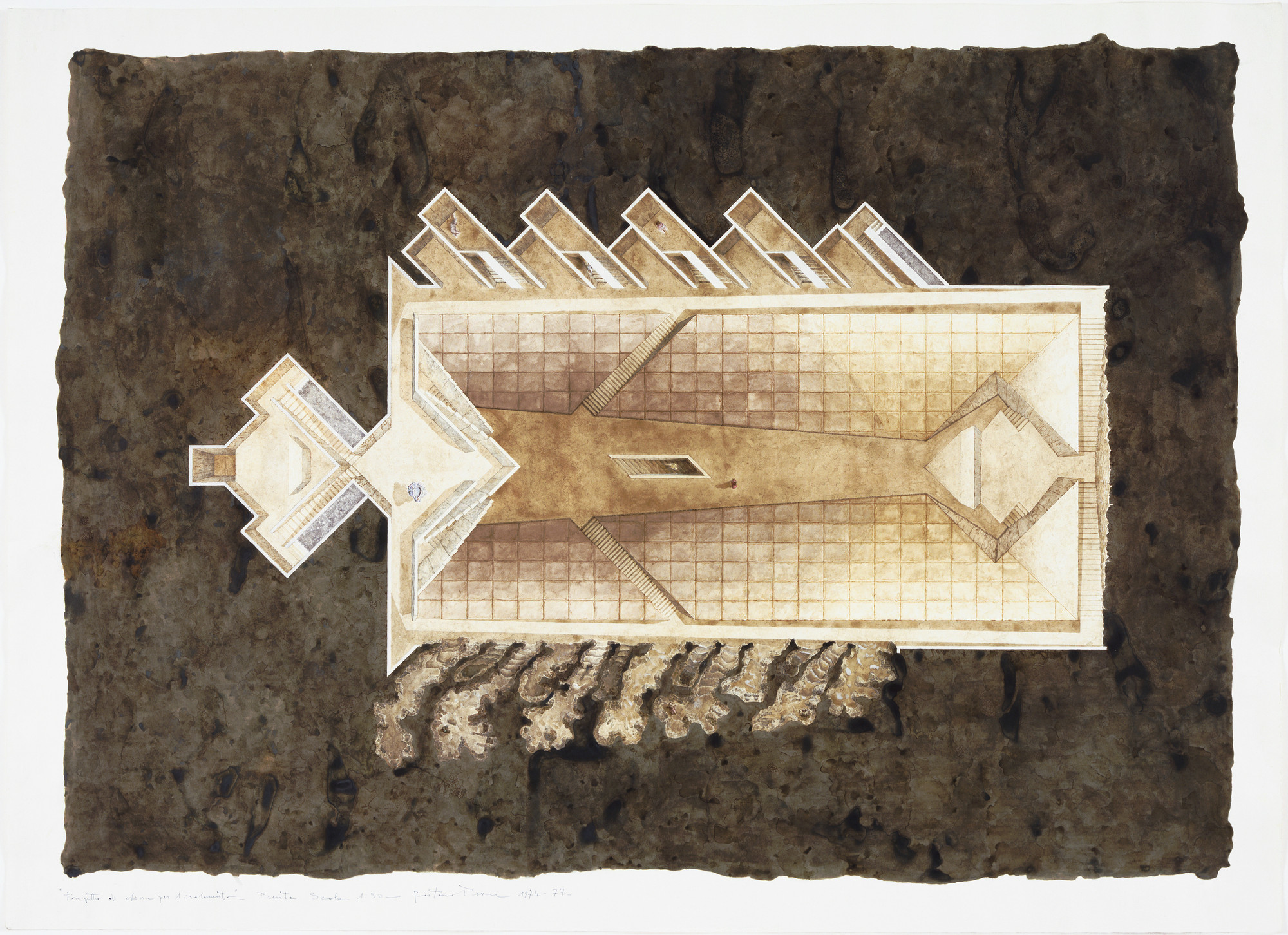
Gaetano Pesce. Church of Solitude, New York, New York. Project, 1974–77. Plan. Watercolor, ink and colored ink, gouache and graphite on paper, 42½ × 58⅝" (107.9 × 148.9 cm)
Gaetano Pesce's Church of Solitude was conceived in reaction to his experience of New York in the 1970s, where he saw people living together, "helter-skelter in crowds." To provide a serene place for introspection and contemplation, he buried the church beneath a vacant lot amid the towers of the city. The silent sanctuary incorporated small individual cells, a further retreat from the city's corporate and institutional culture. An excavated landscape was, for Pesce, an overlooked space that could provide for people's future needs.
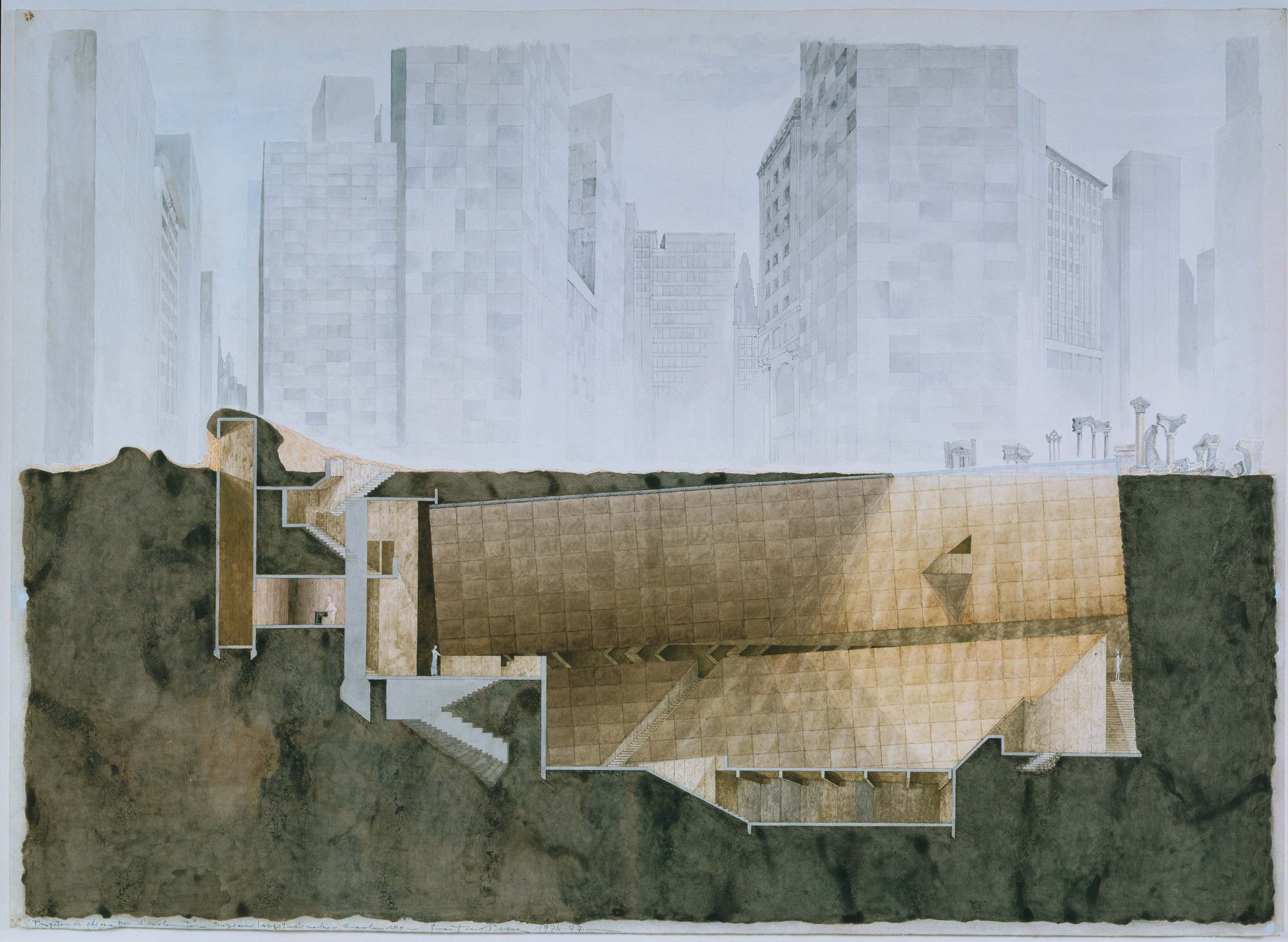
Gaetano Pesce. Church of Solitude, New York, New York. Project, 1974–77. Longitudinal section. Watercolor, ink and colored ink, gouache and graphite on paper, 42½ × 58⅝" (107.3 × 148.9 cm)
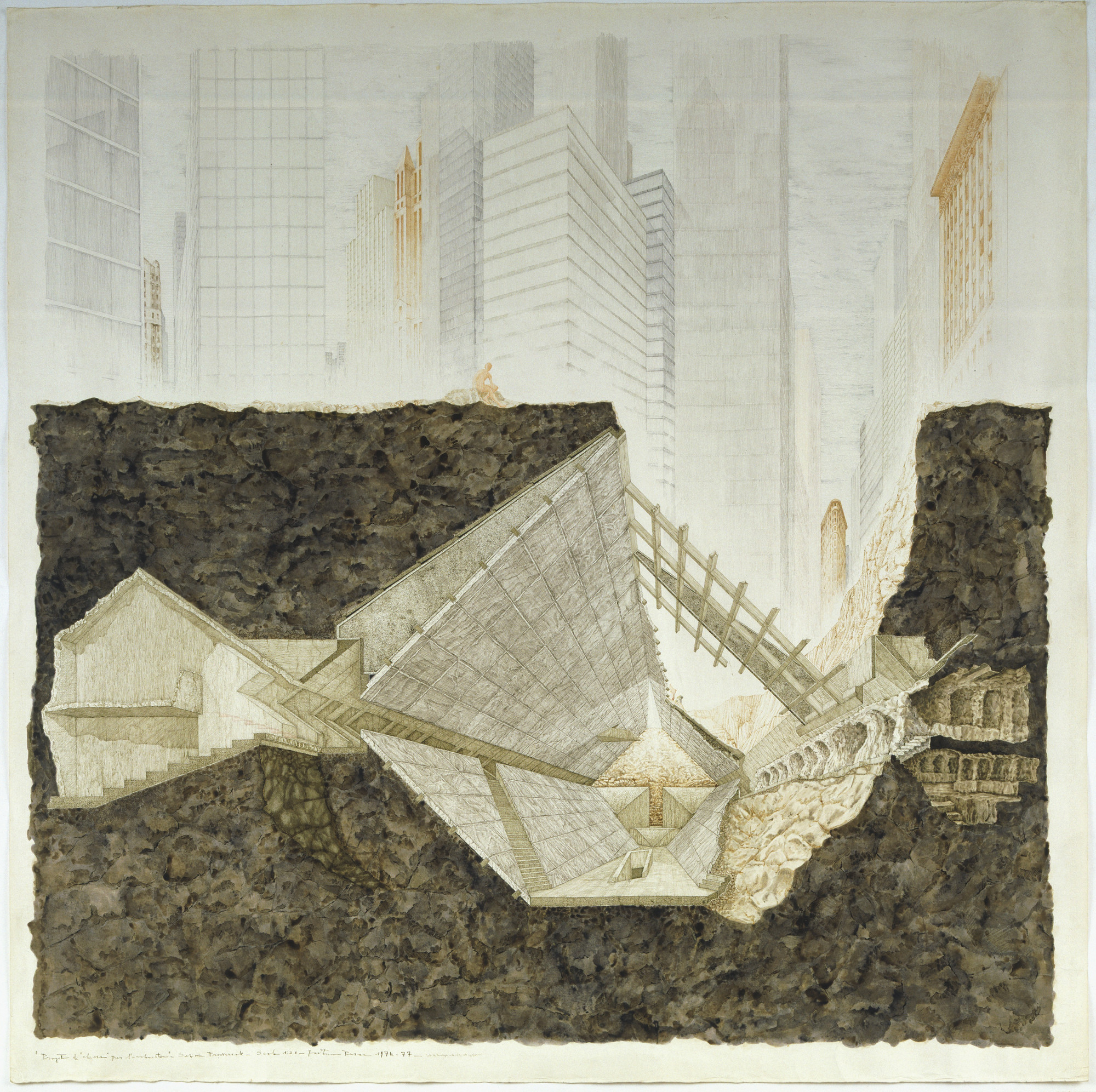
Gaetano Pesce. Church of Solitude, New York, New York. Project, 1974–77. Transverse section. Watercolor, colored ink, and pencil on paper, 58⅞ × 58⅞" (149.5 × 149.9 cm)
Aldo Rossi
Italian, 1931–1997
and Gianni Braghieri
Italian, born 1945
with J. da Nobrega
Portugese, born 1945
and J. Charters
Italian, born 1945
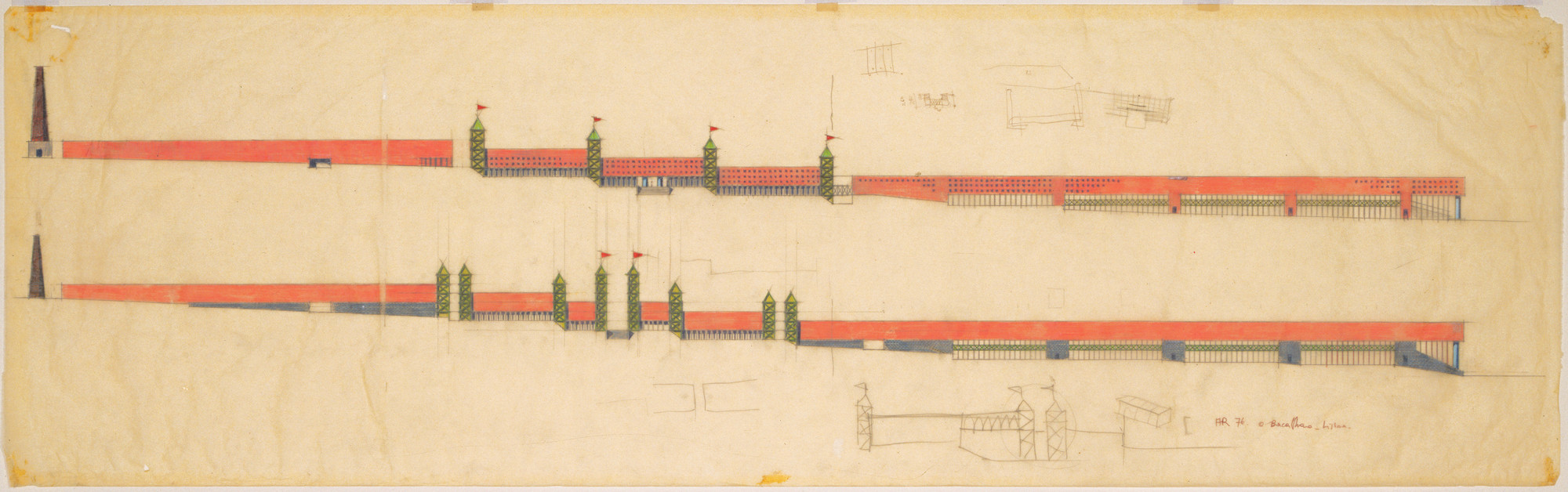
Aldo Rossi, Gianni Braghieri, J. da Nobrega, J. Charters. Housing, Setubal, Lisbon, Portugal. Project, 1975–76. Elevation (1975). Color pencil, graphite, and felt-tipped pen on tracing paper, 18 × 57½" (45.7 × 146.1 cm)
Aldo Rossi's unbuilt housing scheme for Setubal, a fishing town outside of Lisbon, was designed for a site that gently slopes toward a coastal highway. While the building's base follows the topography, the roofline remains constant, stepping down once near the mid-point and creating two giant steps in the landscape. The lower building becomes a terrace overlooking the sea. As the ground recedes, Rossi's characteristic rectilinear forms are supported on pilotis, which create covered walkways with adjacent shops and community facilities. A water tower, echoing the industrial setting, marks an entrance to the building, while other similar cylindrical structures flag locations where streets cross below.
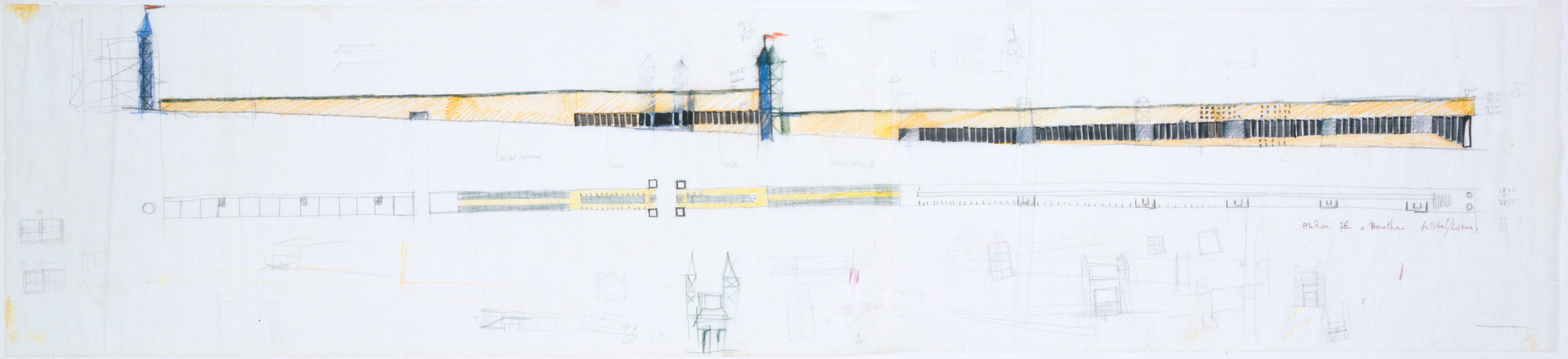
Aldo Rossi, Gianni Braghieri, J. da Nobrega, J. Charters. Housing, Setubal, Lisbon, Portugal. Project, 1975–76. Elevation (1975). Crayon, graphite, and felt-tipped pen on tracing paper, 15 × 65½" (38.1 × 166.4 cm)
Walter Pichler
Austrian, born 1936
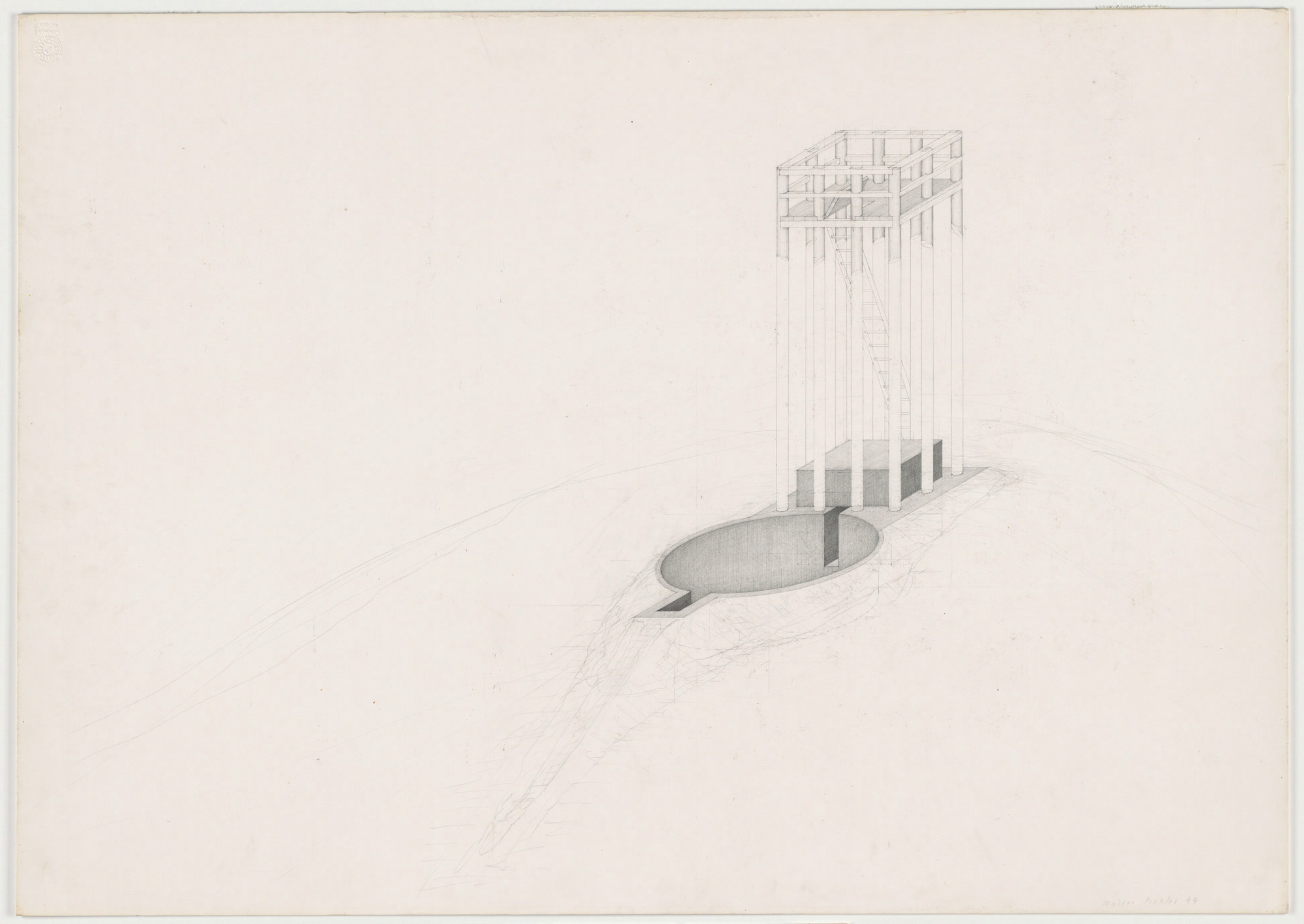
Walter Pichler. Observatory. Project, 1974. Perspective. Graphite on illustration board, 24½ × 34½" (62.2 × 87.6 cm)
Walter Pichler, an influential Austrian avant-garde figure of the mid-1970s, collaborated at times with Raimund Abraham and Hans Hollein. His own highly individual and personal drawings conjure up lost civilizations and abandoned dwellings. Large Figure with an Organ, Two Rooms, Observatory and Pillars Under the Shed are all intimate isolated structures, in some cases partially buried. For Pichler they house the loneliness and solitude of the mind, and recall dreamlike images, past feelings, and childhood memories. Pichler is primarily known as a sculptor rather than an architect; the structures represented in his somber, monochromatic drawings are not delimited by their utility but would, he believed, ultimately find their own usefulness.
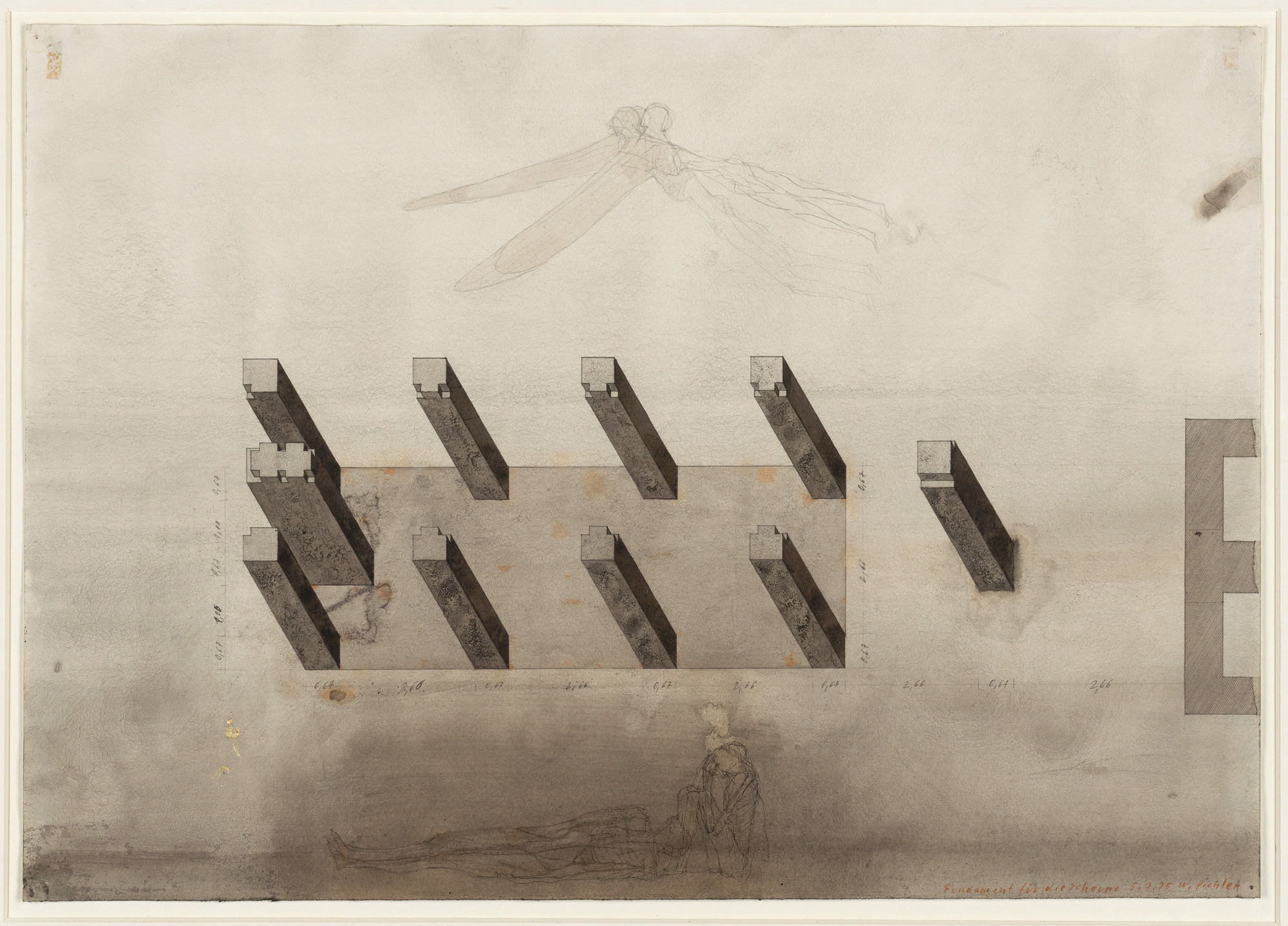
Walter Pichler. Pillars under the Shed. Project, 1975. Aerial perspective. Ink, colored ink, and graphite on paper, 13⅜ × 19¼" (34 × 48.9 cm)
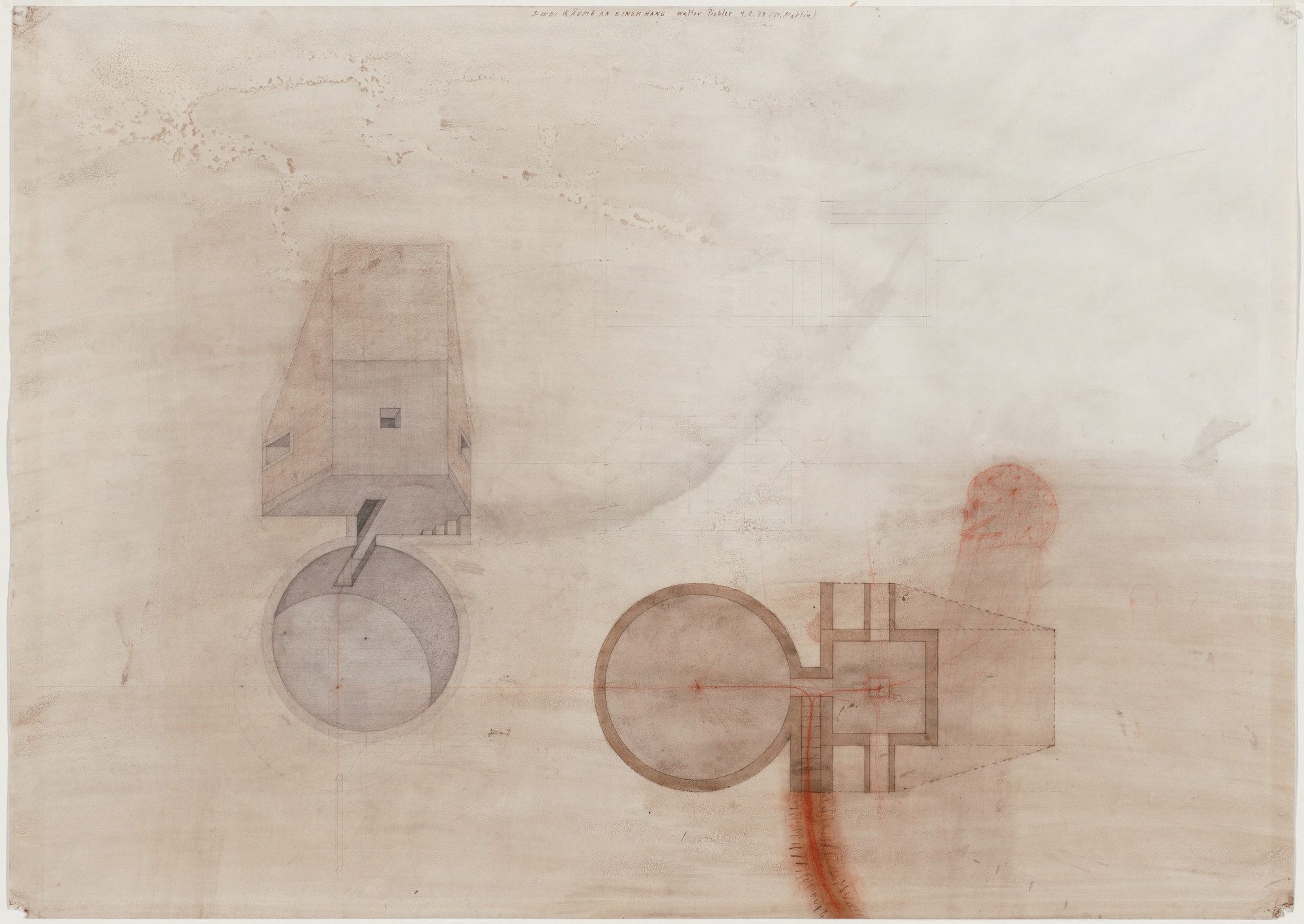
Walter Pichler. Two Rooms. Project, 1975. Perspective and plan. Ink, graphite, and color pencil on paper, 19⅛ × 27" (48.6 × 68.6 cm)
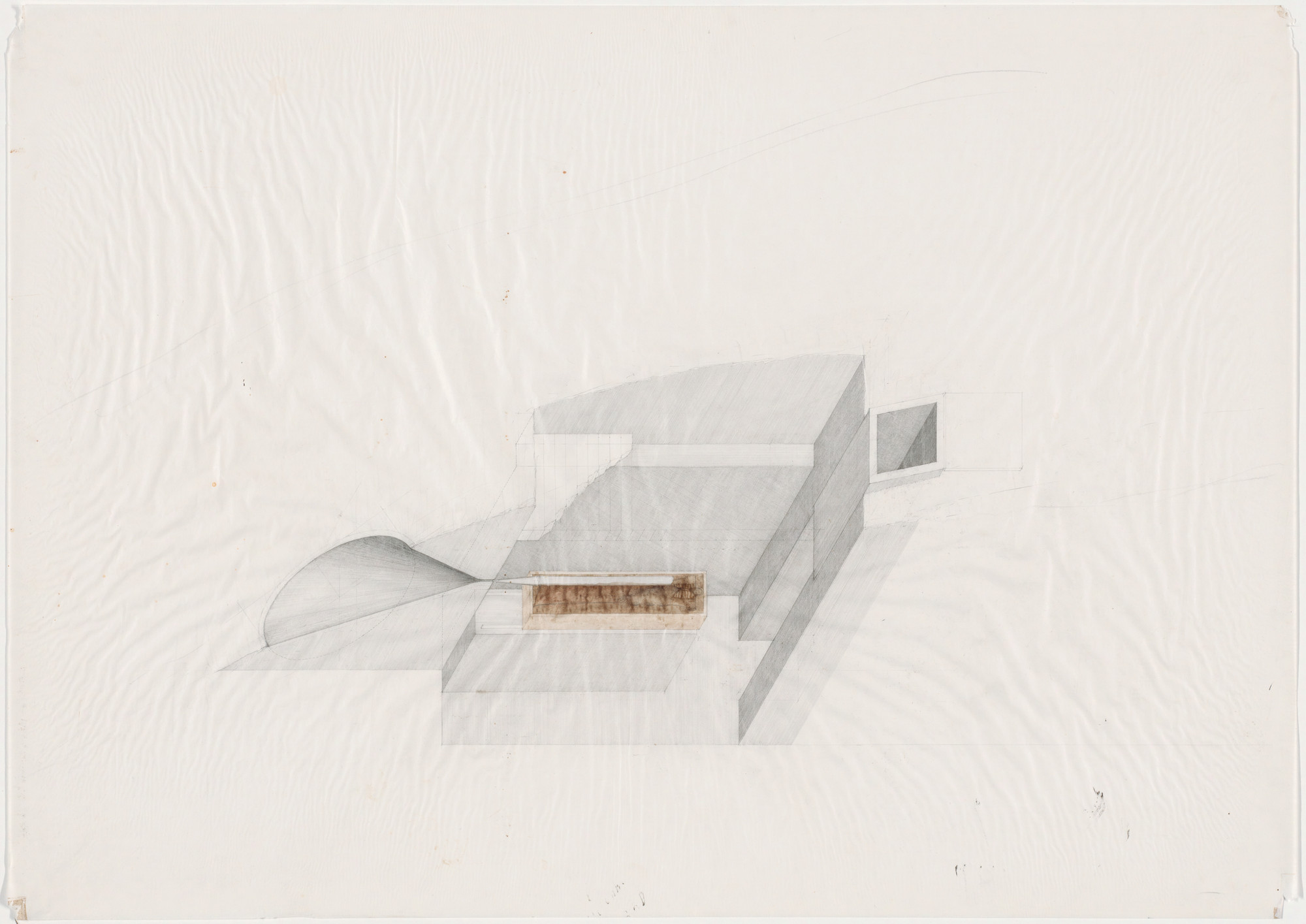
Walter Pichler. Large Figure with an Organ. Project, 1977. Axonometric. Graphite and watercolor on paper, 24 × 33¾" (61 × 85.7 cm)
Rodolfo Machado
American, born Argentina 1942
and Jorge Silvetti
American, born Argentina 1942
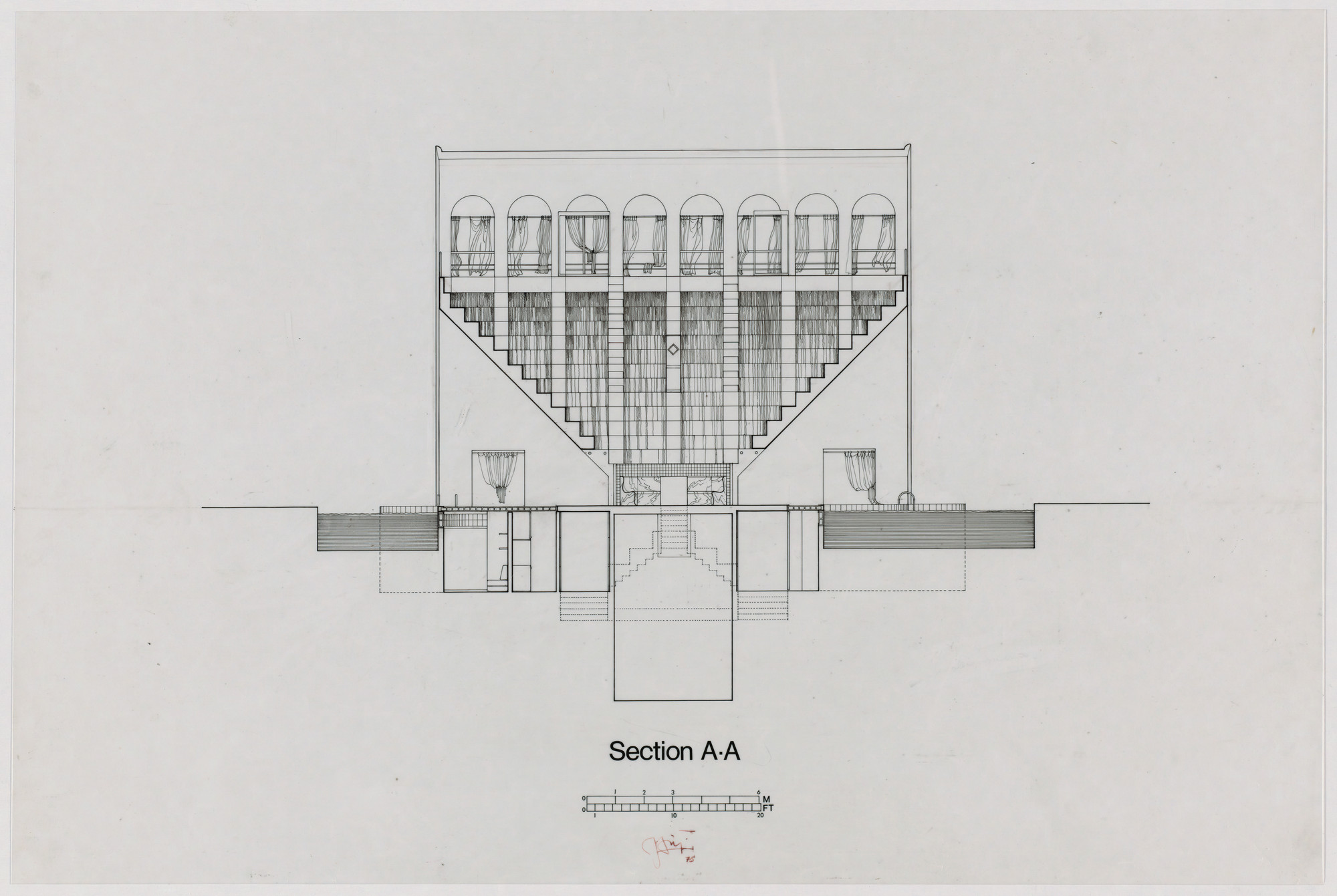
Rodolfo Machado, Jorge Silvetti. Fountain House. Project, 1975. Section A-A. Ink, self-adhesive lettering, and graphite on frosted polymer sheet, 24 × 36" (61 × 91.4 cm)
Fountain House had no client or site, although it was designed with an artist couple in mind and possibly situated in southern California. Conceived as a commentary on the programmatic, functionalist, and rationalist concerns of modernism, it stresses instead the artistic and creative nature of architecture. The form begins with an image or a fiction; in this case, the section recalls a fountain and the plan a face. The architecture is meant to transform the real environment into a space that approaches the imaginary, a place where beauty is primary.
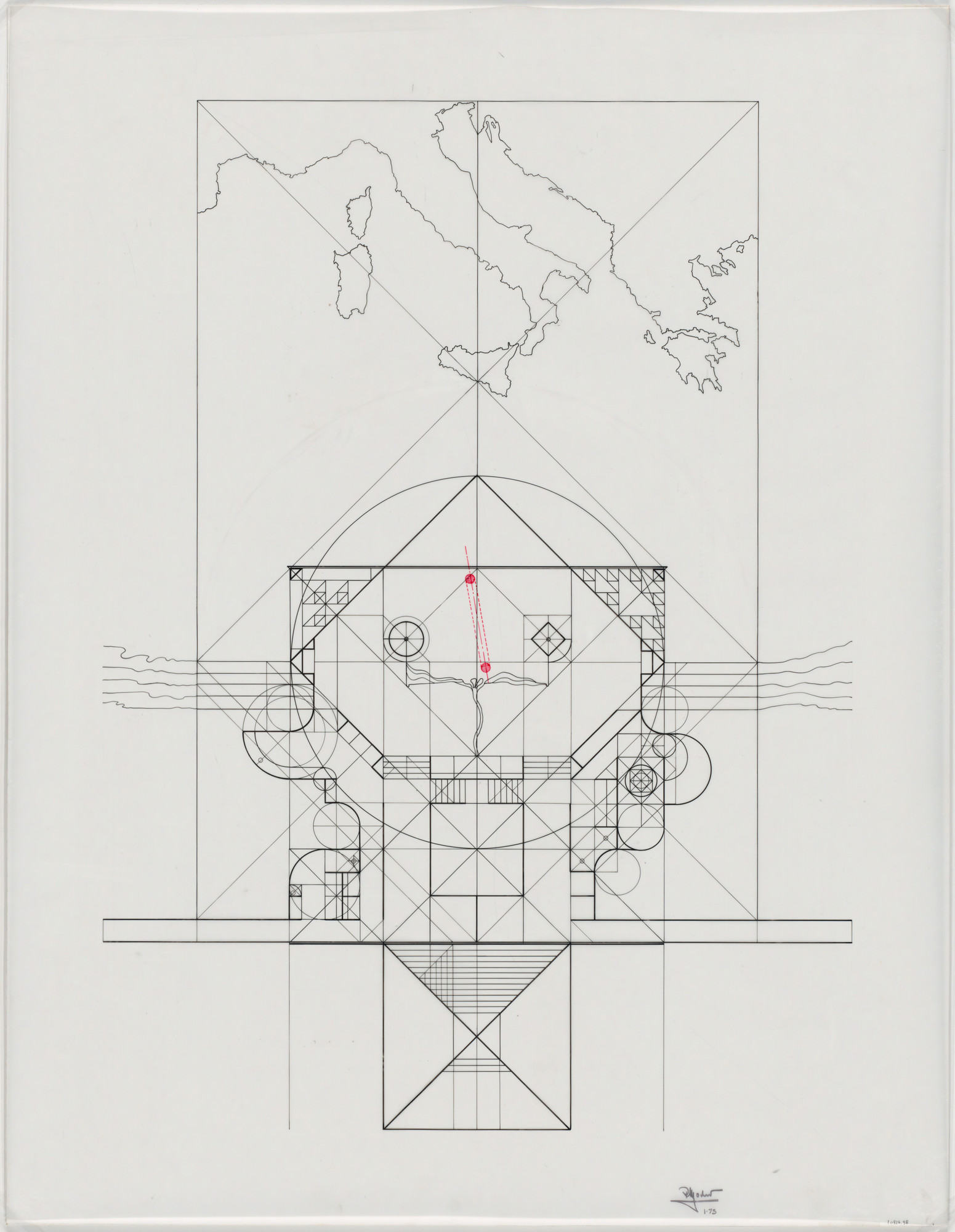
Rodolfo Machado, Jorge Silvetti. Fountain House, Generative Geometries. Project, 1975. Plan. Ink on polymer sheet, 41¾ × 32¼" (106 × 81.9 cm)
Elia Zenghelis
British, born Greece 1937
and Zoe Zenghelis
British, born Greece 1937

Elia Zenghelis, Zoe Zenghelis. Hotel Sphinx, New York, New York. Project, 1975–1976. Axonometric. Synthetic polymer paint and ink on paper, 18⅜ × 22" (46.7 × 55.9 cm)
Elia and Zoe Zenghelis designed the Hotel Sphinx for Times Square, at the intersection of Broadway and Seventh Avenue, that was included in Rem Koolhaas's book, Delirious New York. It proposed an urban hotel as a model for mass housing. Each physical part of the hotel as sphinx accommodates different programmatic functions: the legs contain escalators ascending to theaters, auditoriums, and ballrooms; the two towers of the tail contain studio apartments; the neck contains social clubs; the head is dedicated to relaxation and sports; and the spine houses hotel rooms, apartments, and villas with terraced gardens. Manhattan was intended to function as an extended lobby providing all possible amenities, and, likewise, the ground floor and mezzanine were designed to draw in the city and to take on the character of the Times Square area, a notoriously seedy neighborhood in the 1970s.
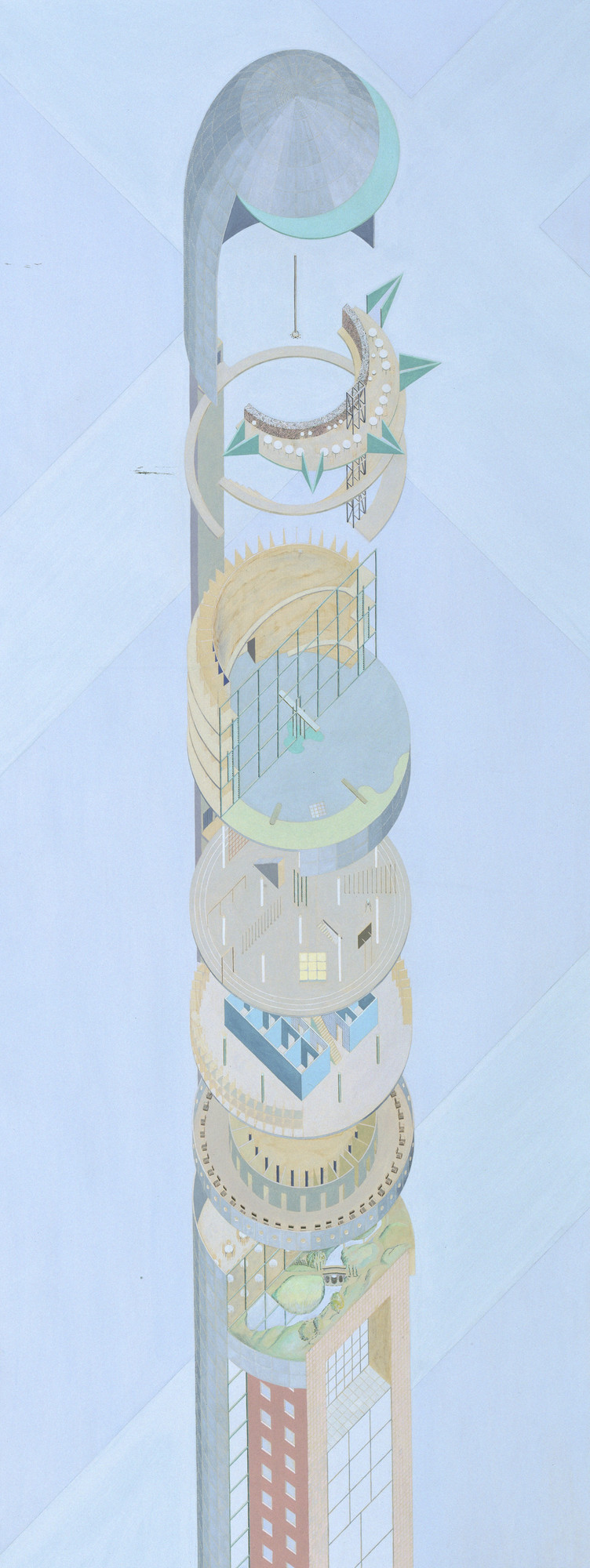
Elia Zenghelis, Zoe Zenghelis. Hotel Sphinx (The Head), New York, New York. Project, 1975–1976. Axonometric (1975). Synthetic polymer paint and ink on paper, 70⅜ × 27½" (178.8 x 69.9 cm)
Rem Koolhaas
Dutch, born 1944
with Elia Zenghelis
British, born Greece 1937
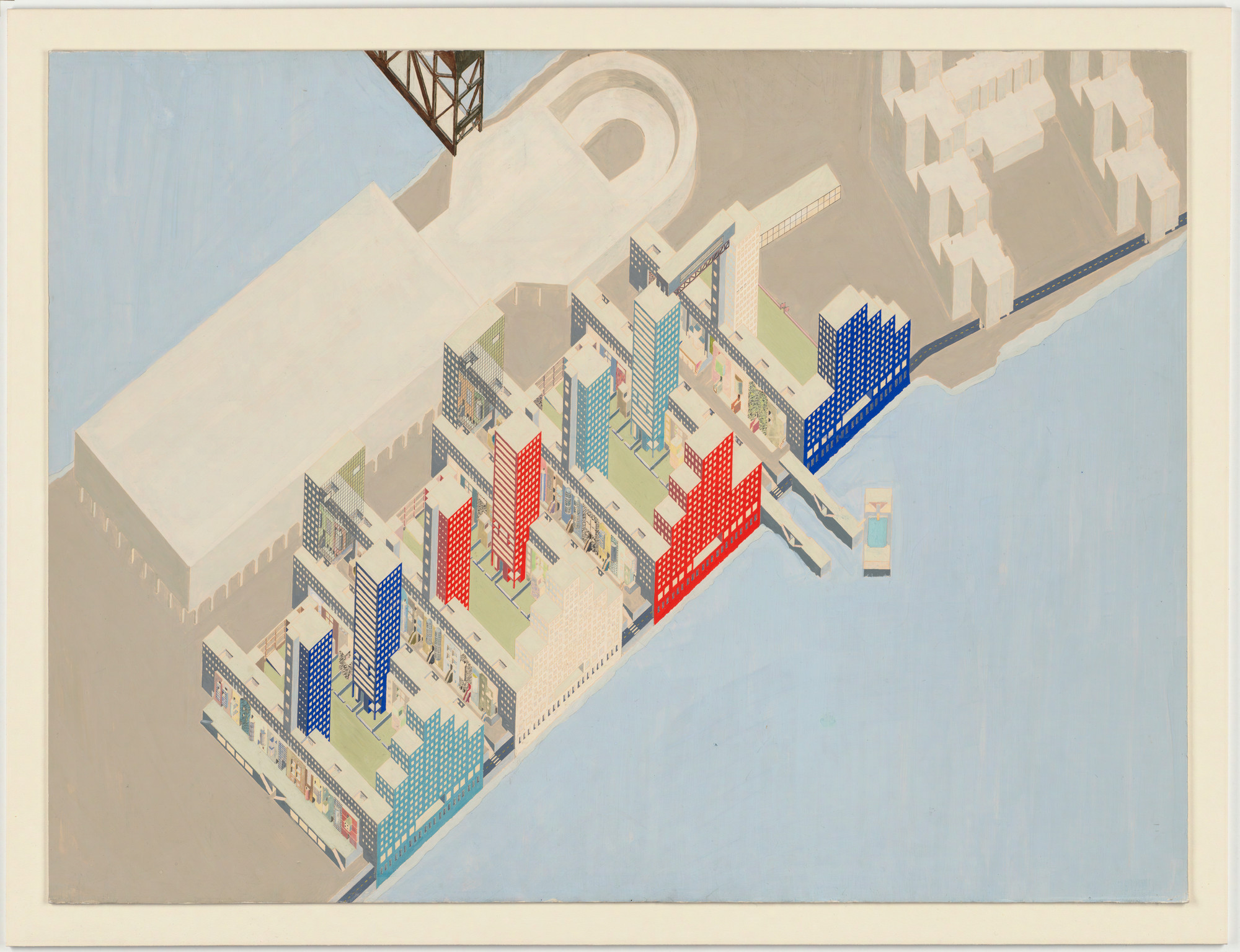
Rem Koolhaas, Elia Zenghelis. Roosevelt Island Redevelopment Project, Roosevelt Island, New York, New York. Project, Axonometric. Gouache and graphite on board, 29 × 38⅝" (73.7 × 98.1 cm)
In the mid-1960s there was a movement to redevelop Roosevelt Island, the narrow strip of land in the East River between Manhattan and Queens, which had been dedicated to hospitals, asylums, and prisons since the early nineteenth century. Rem Koolhaas and Elia Zenghelis entered a 1974 competition for the north end of the island, with a strategy to map elements, concepts, and typologies based on nearby Manhattan, in contrast to earlier plans, which had ignored the island's urban context. Thus, they literally extended the city grid between Seventy-first and Seventy-fifth streets to Roosevelt Island. As in Manhattan, Seventy-second Street was to be a main thoroughfare lined with shops and restaurants. Rows of "synthetic brownstones" made from glass, rock, plastic, marble, and aluminum were framed by highrise buildings situated so as to maximize the views.
Rem Koolhaas
Dutch, born 1944
with German Martunez
Colombian
and Richard Perlmutter
American
Painting by Zoe Zenghelis
British, born Greece 1937
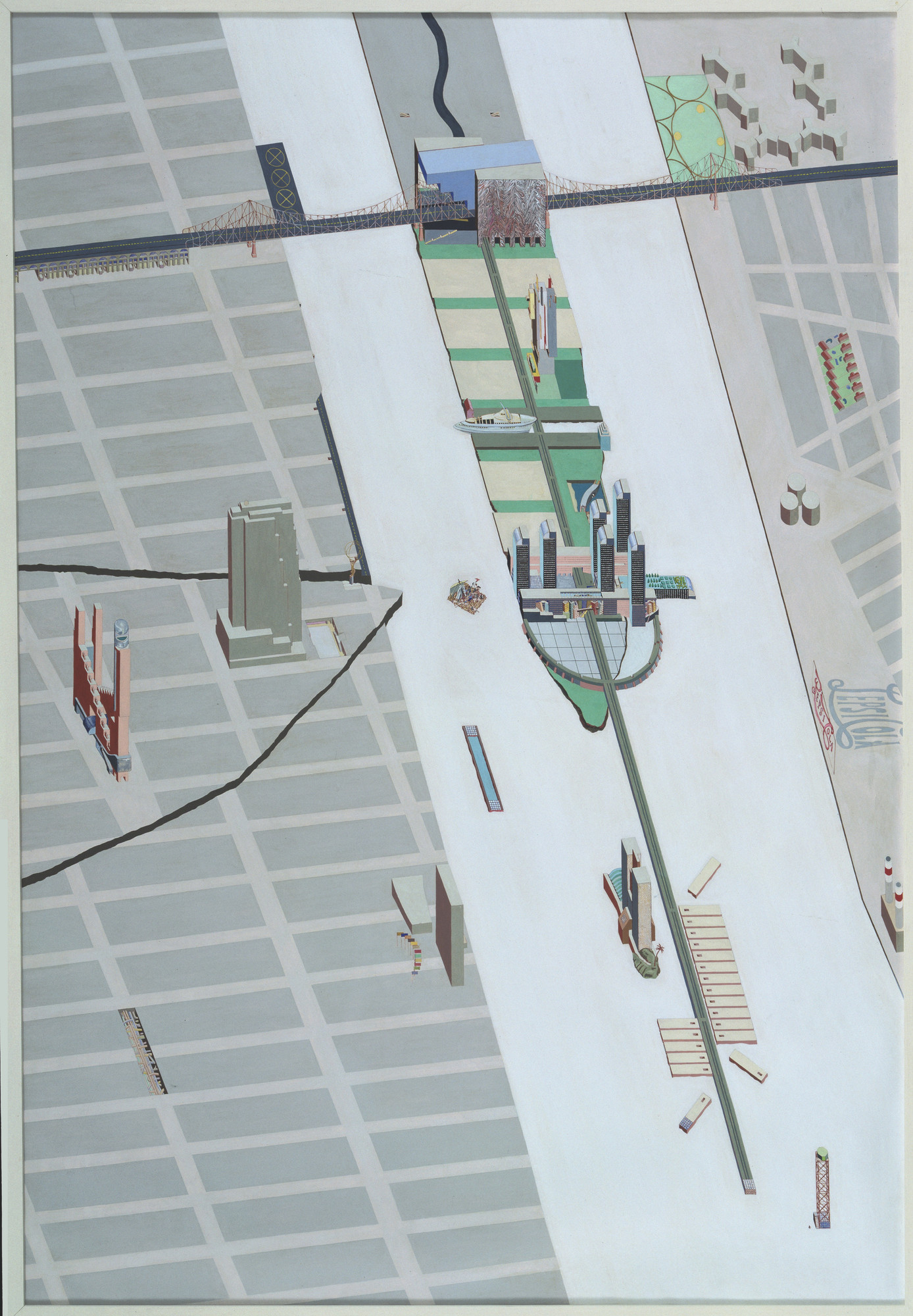
Rem Koolhaas, Zoe Zenghelis. New Welfare Island, Roosevelt Island, New York, New York. Project, 1975–76. Aerial perspective. Gouache on paper, 58 × 40" (147.3 × 101.6 cm)
Rem Koolhaas, German Martinez, and Richard Perlmutter designed New Welfare Island for the south end of Roosevelt Island (once known as Welfare Island). This theoretical project extended Manhattan's grid, in this case between Fiftieth and Fifty-ninth streets, onto the island, in a manner similar to that used for Koolhaas's and Zenghelis's Roosevelt Island Redevelopment competition entry. Each newly created lot was intended to support competing structures—formally, ideologically, and programmatically—corresponding to what they viewed as Manhattan's dominant characteristic. Just north of the "travelator," a moving pavement extending to the rivers, is a convention center. To its south, amid vacant lots reserved for future use, are Kazimir Malevich's "Architecton," an interior harbor housing a 1932Norman Bel Geddes yacht, and a "Chinese" swimming pool. The New Welfare Hotel, a city within a city, which looks toward Manhattan, is situated at the bottom of the island.
Rem Koolhaas
Dutch, born 1944
with Richard Perlmutter
American
and Derick Snare
American, born 1952
Painting by Madelon Vriesendorp
Dutch, born 1945
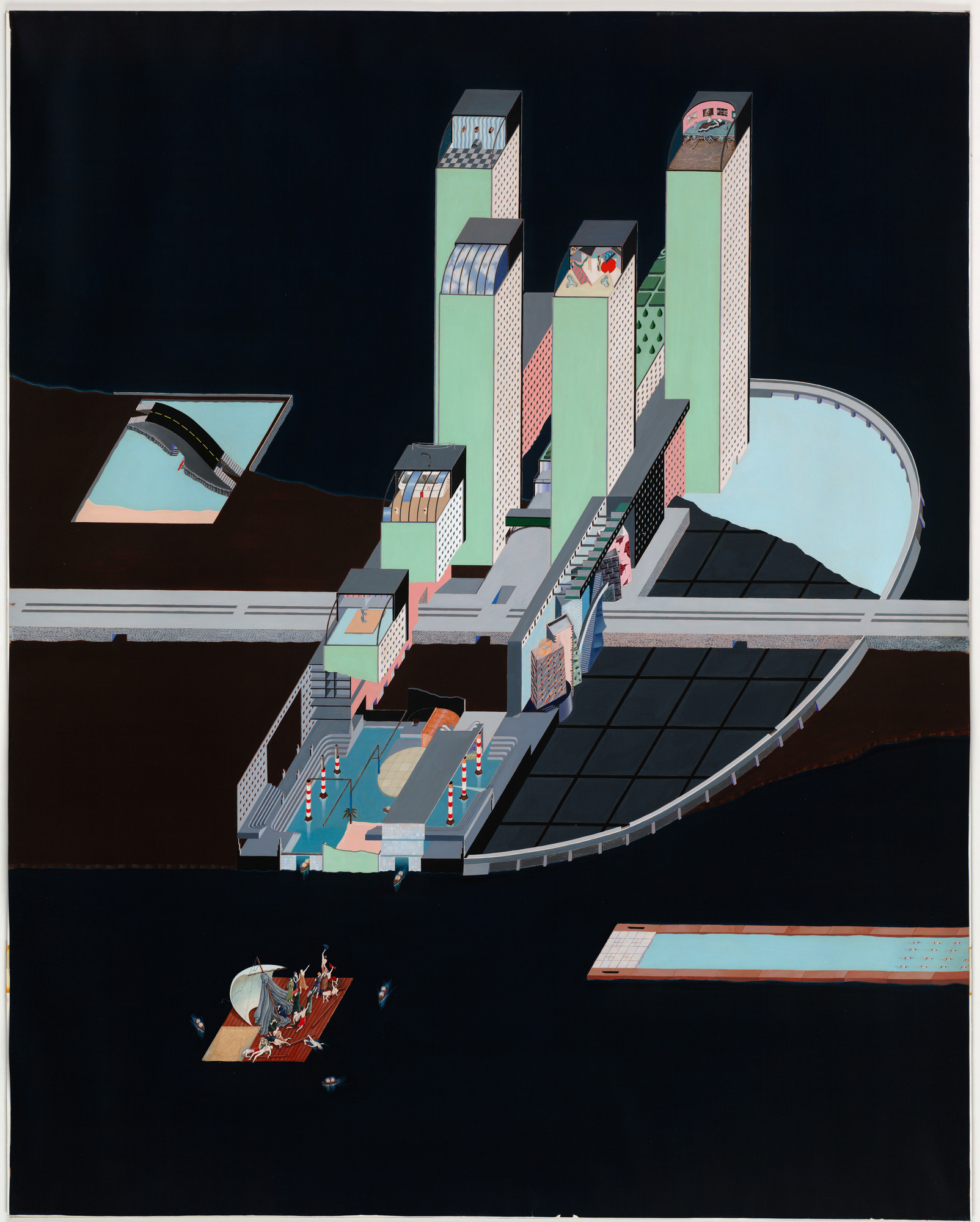
Rem Koolhaas, Madelon Vriesendorp. Welfare Palace Hotel, Roosevelt Island, New York, New York. Project, 1976. Cutaway axonometric. Gouache on paper, 51 × 40½" (129.5 × 102.9 cm)
11 мая 2026, 23:09
0 комментариев
|
Партнёры
|






Комментарии
Добавить комментарий