
|
|
|

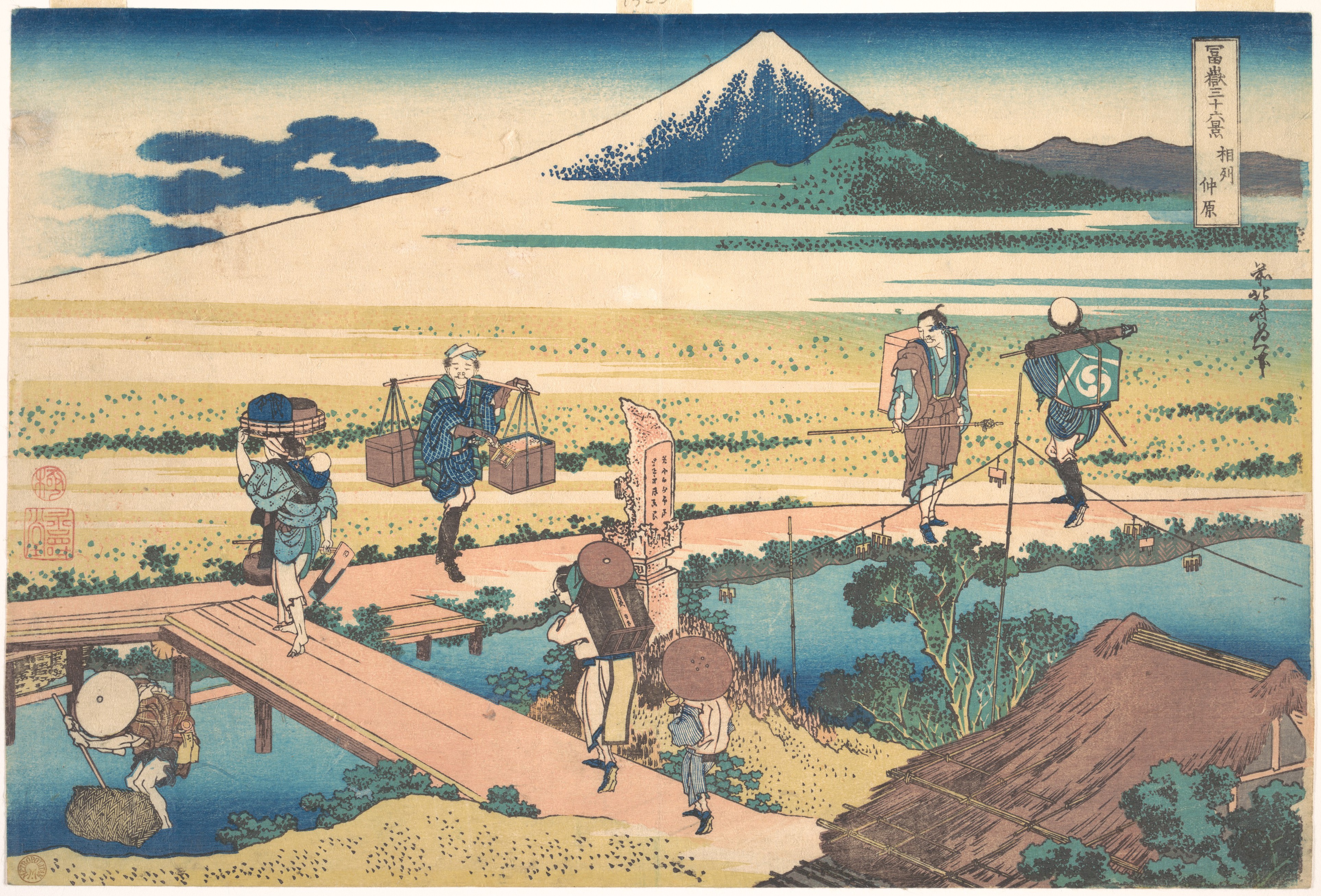
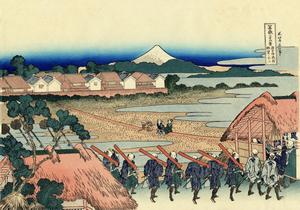
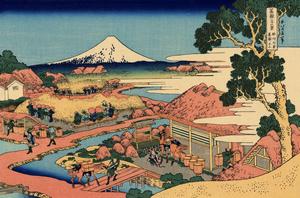
Кацусика Хокусай. Тридцать шесть видов Фудзи: № 26. Накахара в провинции Сагами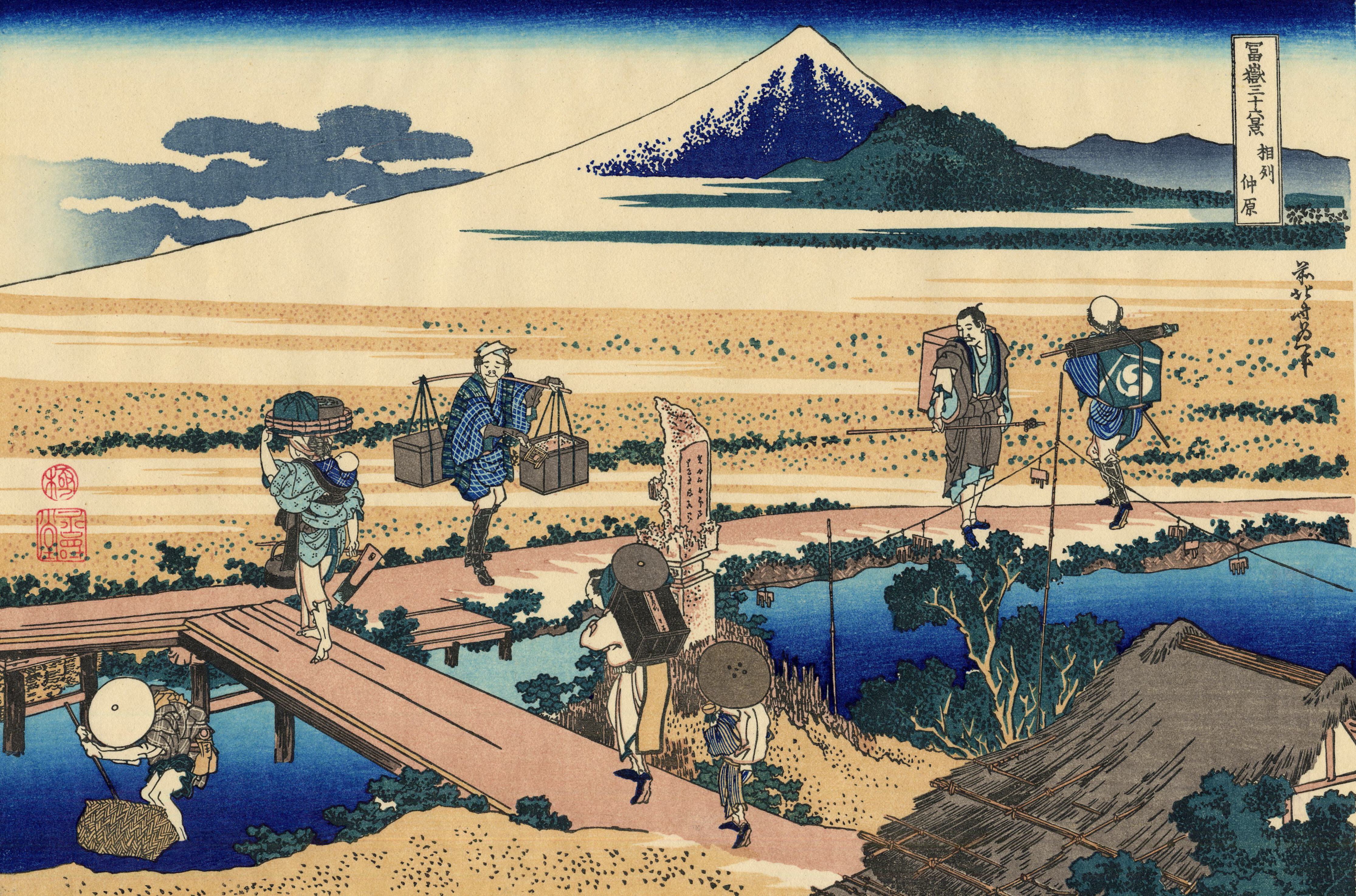
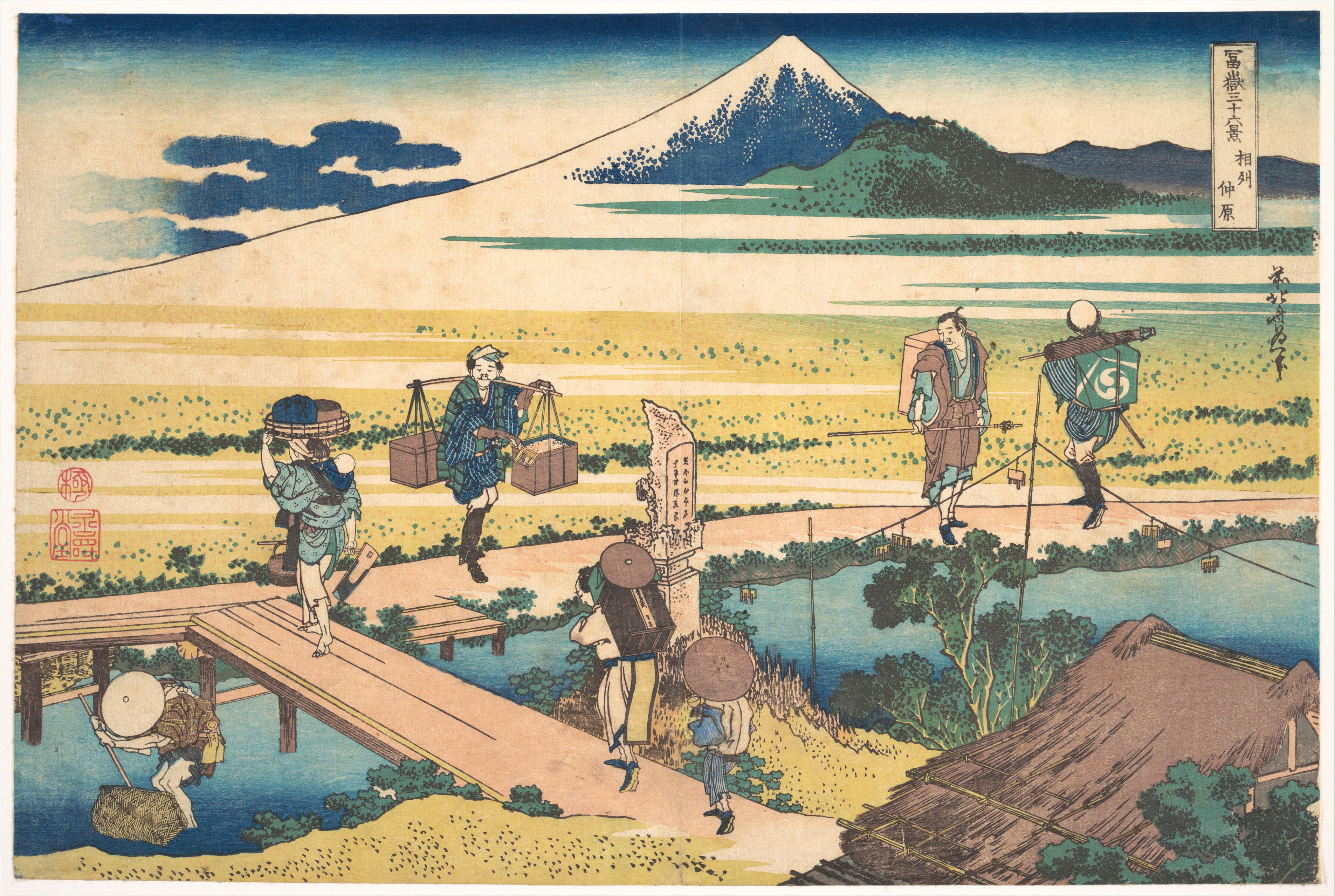
Katsushika Hokusai. Nakahara in Sagami Province, from the series Thirty-six Views of Mount Fuji
冨嶽三十六景 相州仲原Nakahara in Sagami Province (Sōshū Nakahara), from the series Thirty-six Views of Mount Fuji (Fugaku sanjūrokkei)Artist: Katsushika Hokusai (1760–1849)Period: Edo period (1615–1868)Date: ca. 1830–32
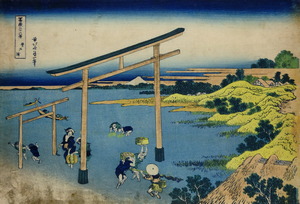
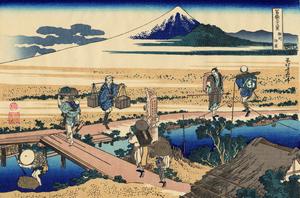
Intrigued by the compositional potential of the plank bridge in the foreground of the upper print, Hokusai appears to have excerpted and used it as the central structuring motif in the lower print. Like a stage, all action takes place on or within the space created by the wooden structure. Hokusai's tendency to repeat the peaked form of the mountain throughout a print's design is seen here in the construction of the thatched rooftops as well in the rattle-laden rope lines used by fishermen to scare off hungry birds. This type of controlled vision is absent from the upper print, the design of which is far less focused and ordered. (metmuseum)
A man at the far right, perhaps a shop clerk (tedai ), pauses on the riverbank to admire the view of Mount Fuji. He wears a typical townsman's kimono with crisp narrow blue and white stripes. The lower part of his kimono is tucked up at the waist for easy walking, showing the kimono's solid blue lining. On his back, he bears an umbrella and a large bundle wrapped in a green cotton furoshiki. A furoshiki can be of any size. A simple square cloth, it wraps almost any object, and its tied ends make a good handle for carrying. When not in use, it conveniently folds into a tiny space. Hokusai and Hiroshige portray travelers carrying furoshiki bundles on the back, at the front or side, tied around the neck, at the waist, or over the shoulders and held straight or diagonally-as many ways as one can imagine. A furoshiki is often decorated with a family crest to identify the status of the family, or with a shop logo that is a form of commercial advertisement. Hokusai places the young man looking at Mount Fuji with his back directly to us so that we can see without distraction the large logo on his green furoshiki: three commas (tomoe) in a circle beneath a triangular form representing a mountain. Just as brand name items are introduced into movies as advertisements, here Hokusai has drawn the logo of his own publisher, Eijudo. (from “Blue and White” textiles exhibition 8/28/2008-)
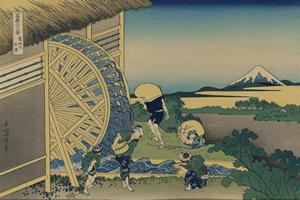
Against the fairly large Mount Fuji with its long flanks, Hokusai depicts a scene where residents and travelers – pilgrims, merchants, a farm woman, and a fisherman – are using a local road. It is one of his more successful simpler compositions. By abbreviating the landscape elements in the middle ground and foreground, Hokusai has created enough space to show the human figures and their lively activities, which are his main interest. As usual, he made the scene interesting with extensive details. For example, the woman with her baby on her back is taking lunch to her husband in the field. She carries the meal in a tub, holding it on her head with her left hand. In her right hand she holds a hoe by the handle, on which she has hung a water kettle. A merchant who looks at Fuji carries his luggage wrapped in cloth with his store sign. Placed atop it is an umbrella. The house in the foreground has a kind of scarecrow: three poles with strings stretched between them, to which rattles are attached. Presumably they sound when the wind blows, or if birds attempt to perch on the string. The season is autumn, as a gold tone fills the middle ground. A simple but rich color scheme is used: two shades of blue, orange, yellow, and green. (The Asian Art Museum of San Francisco, HOKUSAI AND HIROSHIGE – Great Japanese Prints from the James A. Michener Collection, Honolulu Academy of Arts: The Asian Art Museum of San Francisco, 1998 Page 94. Cat. 45)
In this print Hokusai presents a cross-section of the kinds of people encountered during a pilgrimage to Mount Fuji. Perhaps most striking is the woman on the bridge, who not only carries a baby on her back and a large wooden tray with wrapped bundles of food for lunch on her head, but also balances an iron kettle on her hoe! A similarly burdened man turns to her, while another villager sifts through the water of the stream with a net. Two pilgrims are about to cross the bridge; the one in front carries a portable shrine on his back. Another pilgrim with a similar shrine waits for them on the road. To the far right, a merchant pauses to admire the view of Mount Fuji; on his back is a bundle playfully marked with the sign of Eijudö, the publisher of the Thirty-six Views series. “Hokusai’s Summit: Thirty-six Views of Mount Fuji” (09/24/2009-01/06/2010)
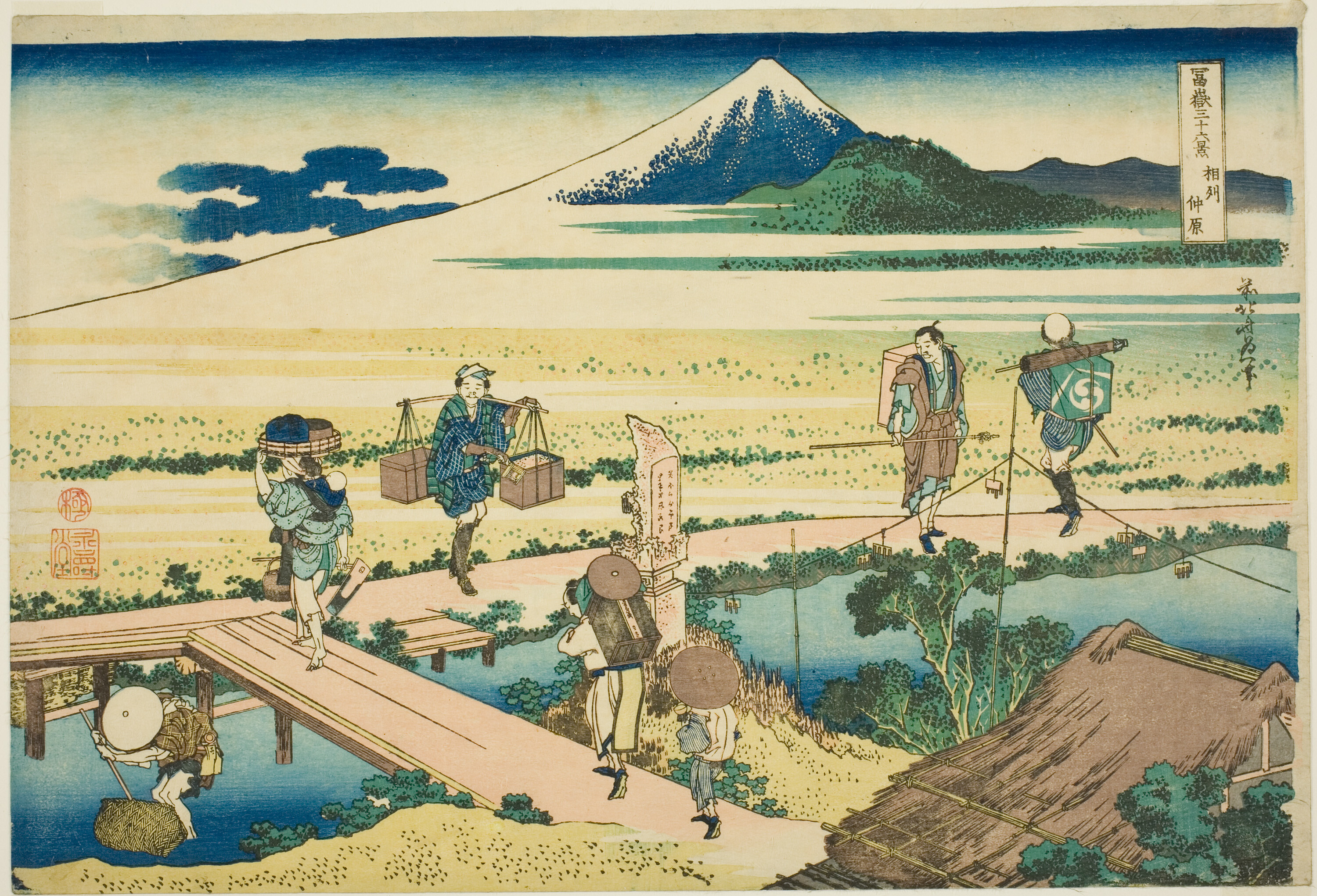
Katsushika Hokusai. Nakahara in Sagami Province, from the series Thirty-six Views of Mount Fuji
Накахара в провинции Сагами
По белому небу плывут синие облака, темно-синяя Фудзи с белоснежной вершиной возвышается в центре. Она как бы остановилась на ночлег среди этих облаков. Холм, в котором прячется подножие горы Фудзи, пока еще зеленый, но поля, на среднем плане, уже по-осеннему желтые. От деревни через маленькую речку переброшен дощатый мост. Его переходит женщина-крестьянка. На голове она несет корзину с обедом «бэнто», а в правой руке держит мотыгу, на которой балансирует подвешенный за ручку чайник. На спине у нее младенец. Позади этой женщины изображены паломники. Мужчина под мостом слева ловит рыбу. На другом берегу, справа от моста, торговец несет коробки, закрепленные с двух сторон шеста. Немного правее изображен буддистский монах с посохом «сякудзё», он повернулся лицом к воде. Другой монах несет котомку, на которой ясно читается торговая марка издательства Эйдзидо Нисимура Ёхати, поверх котомки прикреплен сложенный зонтик. Он повернулся лицом к Фудзи и любуется ею.
В правом углу листа, перед рекой мы видим крышу дома, крытую соломой. Вдоль реки висят трещетки, отпугивающие птиц, у самого моста возвышается надгробный камень. Накахара — это маленькая деревушка, находящаяся на расстоянии около двух километров от станции Хирацука на севере дороги Токайдо. Позже она стала частью деревни Оно, а в настоящее время включена в состав города Хирацука. Известно, что в 18 году периода Тэнсё (1590 год) она была включена в район Канто. В 6 году периода Кэйтё (1601 год) главой правления Накахара был назначен Найто Киёнари. Находясь на службе у сегуна Токугава Иэясу, в провинции Сагами, в подаренной ему Накахара он соорудил поместье, которым пользовался во время соколиной охоты. Впоследствии, когда Хокусай создавал эту гравюру, от поместья не осталось и следа.
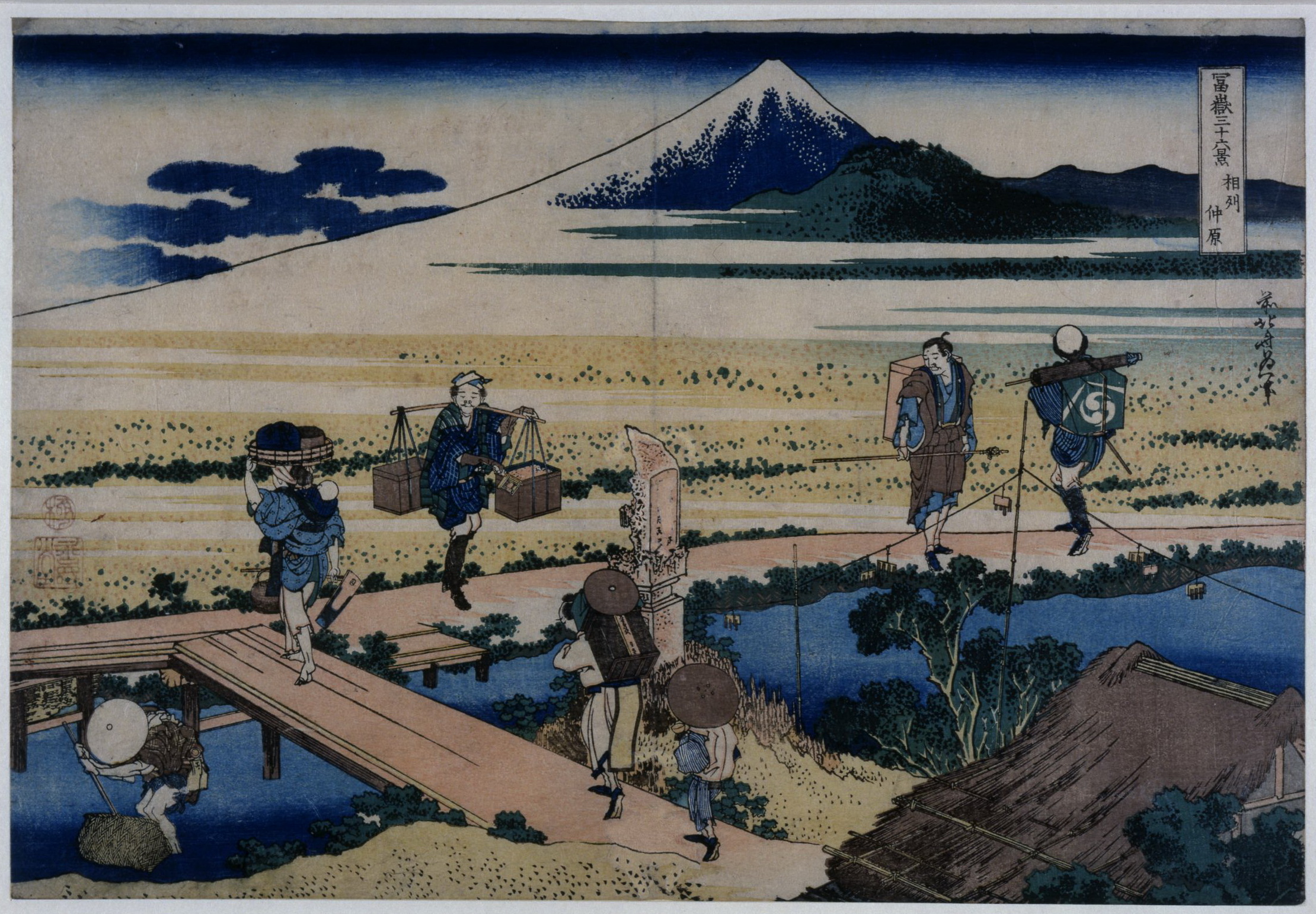
Katsushika Hokusai. Nakahara in Sagami Province, from the series Thirty-six Views of Mount Fuji
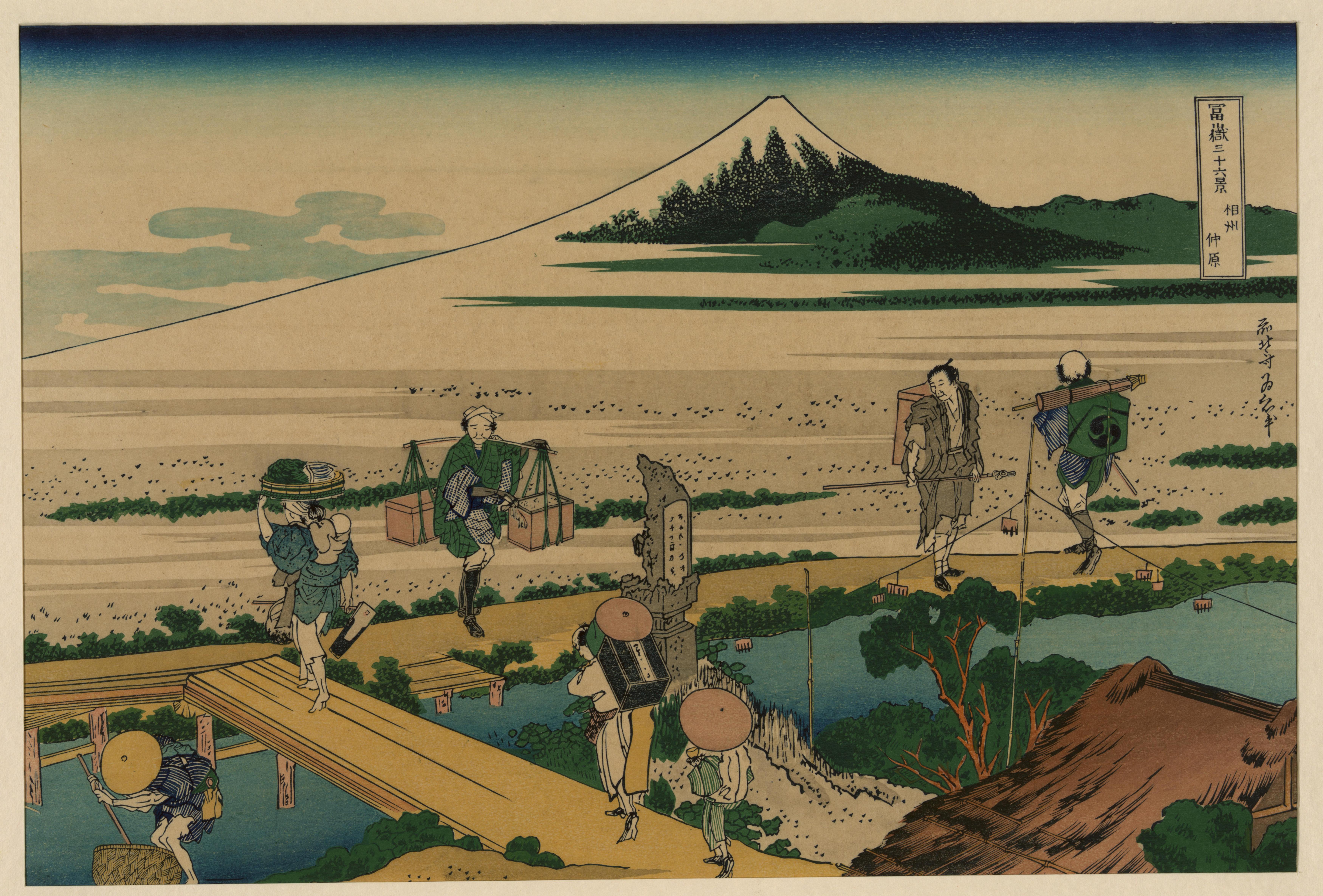
Katsushika Hokusai. Nakahara in Sagami Province, from the series Thirty-six Views of Mount Fuji
Katsushika Hokusai. Nakahara in Sagami Province, from the series Thirty-six Views of Mount Fuji
Katsushika Hokusai. Nakahara in Sagami Province, from the series Thirty-six Views of Mount Fuji
Все 46 гравюр серии «Тридцать шесть видов Фудзи» | Thirty-six Views of Mount Fuji | 富嶽三十六景 | Fugaku Sanjūrokkei
6 марта 2023, 20:32
0 комментариев
|
Партнёры
|






Комментарии
Добавить комментарий